


Solar Battery Backup | South Florida
Keep Your Home Powered Through Outages with Solar Battery Backup
Pair battery storage with solar panels to store energy and protect your home when the grid goes down. ASP Superhome designs and installs complete systems for Miami, Fort Lauderdale, West Palm Beach, and beyond.
By Jonathan Rodriguez · Published September 15, 2026
Solar Battery Backup for South Florida Homes: Whole-Home Power Through Storms and Outages
Solar battery backup stores energy generated by your solar panels during the day so you can use it during power outages, nighttime hours, or peak-rate periods—providing both resilience and potential energy savings. In South Florida, where hurricane season, aging grid infrastructure, and frequent localized outages are facts of life, a battery backup system transforms your solar investment from a daytime energy source into a round-the-clock power solution.
This guide covers how solar battery backup works, sizing and capacity for South Florida homes, installation and safety requirements, costs and incentives, and how to prepare for hurricane season. Whether you’re installing solar for the first time or adding battery storage to an existing system, understanding your options helps you make a decision that fits your home and your peace of mind.
Not sure what your next step is?
Talk it through with our team — the first consultation is free, confidential, and carries no obligation.
What Is Solar Battery Backup and Why South Florida Homeowners Need It
A solar battery backup system is a rechargeable energy storage unit paired with solar panels (or added to an existing solar installation) that captures excess solar energy during daylight hours and releases it when you need it most—during outages, after sunset, or when grid electricity rates spike.
In South Florida, the case for battery backup is compelling. The region experiences hurricane season from June through November, aging electrical infrastructure in many communities, and frequent localized outages from weather, equipment failures, and grid strain during peak cooling demand. A battery backup system keeps your air conditioning, refrigeration, lights, and critical circuits running when the grid fails—without the fuel, noise, emissions, or maintenance demands of a backup generator.
Battery backup also offers financial benefits. If your utility offers time-of-use (TOU) rates—lower rates during off-peak hours and higher rates during peak demand—a battery system lets you store cheap off-peak energy and use it during expensive peak hours, lowering your monthly bill. Some utilities also offer demand-response programs that pay you to shift energy use or discharge your battery during grid emergencies.
Unlike a standalone backup generator, a grid-tied solar system with battery backup uses special anti-islanding equipment to safely disconnect from the grid and operate independently when power fails. This means you’re not burning fuel; you’re using stored solar energy. And unlike a generator, your battery system runs silently and produces zero emissions—an important consideration in South Florida neighborhoods where noise and air quality matter.
How Solar Battery Backup Works During Power Outages
When the grid is running normally, your solar panels generate electricity during the day. Excess power charges your battery. At night or on cloudy days, you draw power from the battery. When the grid fails, an automatic switchover disconnects your home from the grid and your battery becomes your power source.
The heart of this system is the inverter—an electronic device that converts DC (direct current) power stored in the battery into AC (alternating current) power that your home’s appliances use. In a grid-tied system with battery backup, the inverter also includes anti-islanding protection, a safety feature that prevents your solar system from feeding power back into the grid when utility workers are repairing downed lines. This protection is required by code and keeps both your home and the grid safe.
When power returns, the inverter automatically reconnects to the grid. Your solar panels resume charging the battery and powering your home. You don’t need to do anything; the switchover is automatic.
Capacity and runtime depend on your battery’s size (measured in kilowatt-hours, or kWh), your home’s power demand, and how much solar recharge you get during the outage. A typical South Florida home might have a 10–20 kWh battery system. On a sunny day with no grid power, that battery can recharge itself during daylight hours, extending your runtime indefinitely. On a cloudy day or during a multi-day outage, runtime is limited to however long the stored energy lasts.
Not all appliances will run on battery backup. Most systems prioritize essential loads: air conditioning (or at least one AC unit), refrigeration, lighting, water pumps, and medical equipment. High-demand appliances like electric ovens, pool pumps, or whole-house heating may be excluded or controlled to prevent the battery from draining too quickly.
Solar Battery Backup Sizing and Capacity for South Florida Homes
Choosing the right battery size starts with understanding your home’s power needs during an outage.
Essential factors include:
- Home square footage and layout – Larger homes with more circuits and appliances draw more power.
- Cooling load – South Florida’s heat means air conditioning is often the largest power consumer. A 3-ton AC unit can draw 3–5 kW while running.
- Appliance mix – Refrigerators, water heaters, pumps, and medical equipment add to the load.
- Desired runtime – Do you want 4 hours of backup, 12 hours, or 24 hours? Or do you want the battery to recharge itself during the day so it can run indefinitely on sunny days?
- Hurricane season readiness – If you’re preparing for a multi-day outage, you’ll need either a larger battery or a system that can recharge itself during daylight.
Typical South Florida systems range from:
- Essential-loads-only backup (5–10 kWh): Powers AC, refrigeration, lighting, and critical circuits for 6–12 hours on stored energy alone. On a sunny day, the battery recharges and can run indefinitely.
- Partial whole-home backup (10–15 kWh): Covers most household circuits except high-demand appliances like electric ovens or pool heaters. Provides 8–16 hours of backup on stored energy.
- Full whole-home backup (15–25+ kWh): Powers your entire home as if the grid were running. Requires a larger investment but offers maximum flexibility and peace of mind.
A professional assessment evaluates your actual power usage, your cooling needs, and your outage resilience goals to recommend the right size. Oversizing wastes money; undersizing leaves you vulnerable during extended outages.
Types of Solar Batteries and Technology Options
Lithium-ion batteries are the industry standard for residential solar storage. They’re efficient (typically 90–95% round-trip efficiency), have a long lifespan (10–15+ years), and require minimal maintenance. They’re also compact, making them easier to install in garages or utility rooms.
Lithium-ion batteries do require proper ventilation, temperature control (ideally 50–85°F), and compliance with fire-safety standards. They’re also more expensive upfront than older lead-acid technology, but their longer lifespan and lower maintenance make them more cost-effective over time.
Each battery system includes a battery management system (BMS)—onboard electronics that monitor the battery’s health, charge and discharge rates, temperature, and safety. The BMS protects the battery from overcharging, deep discharge, and thermal runaway (a rare but serious failure mode). Most modern systems allow remote monitoring via smartphone app, so you can check your battery’s charge level and performance anytime.
Battery degradation is normal. Most lithium-ion batteries retain 80–90% of their capacity after 10 years of daily use. Warranties typically guarantee this level of performance. After 15–20 years, the battery may still work but at reduced capacity.
Solar Battery Backup vs. Generators: What’s Right for South Florida
Both battery backup and backup generators can power your home during an outage. Here’s how they compare:
| Factor | Solar Battery Backup | Backup Generator |
|---|---|---|
| Fuel | Solar energy (free after installation) | Gasoline, propane, or diesel (ongoing cost) |
| Maintenance | Minimal; no oil changes or spark plugs | Regular maintenance: oil changes, filter replacement, fuel stabilization |
| Noise | Silent | 70–90 decibels (loud) |
| Emissions | Zero | CO₂, NOx, particulates |
| Runtime | Limited to battery capacity; recharges on sunny days | Unlimited, as long as fuel is available |
| Startup | Automatic; no action needed | Manual start or automatic; requires fuel on hand |
| Cost | $10,000–$25,000+ installed | $5,000–$15,000 installed |
| Lifespan | 10–20+ years | 10–15 years with maintenance |
For South Florida homeowners, battery backup offers silent, emission-free power and no fuel logistics. However, a generator provides unlimited runtime if you have fuel. Some homeowners choose both: a battery system for short outages and quick backup, plus a generator for extended storms when solar recharge is limited.
Have questions about what happened?
Ask our team directly. The first conversation is free, confidential, and there is no obligation to continue.
Installation, Placement, and Safety Considerations
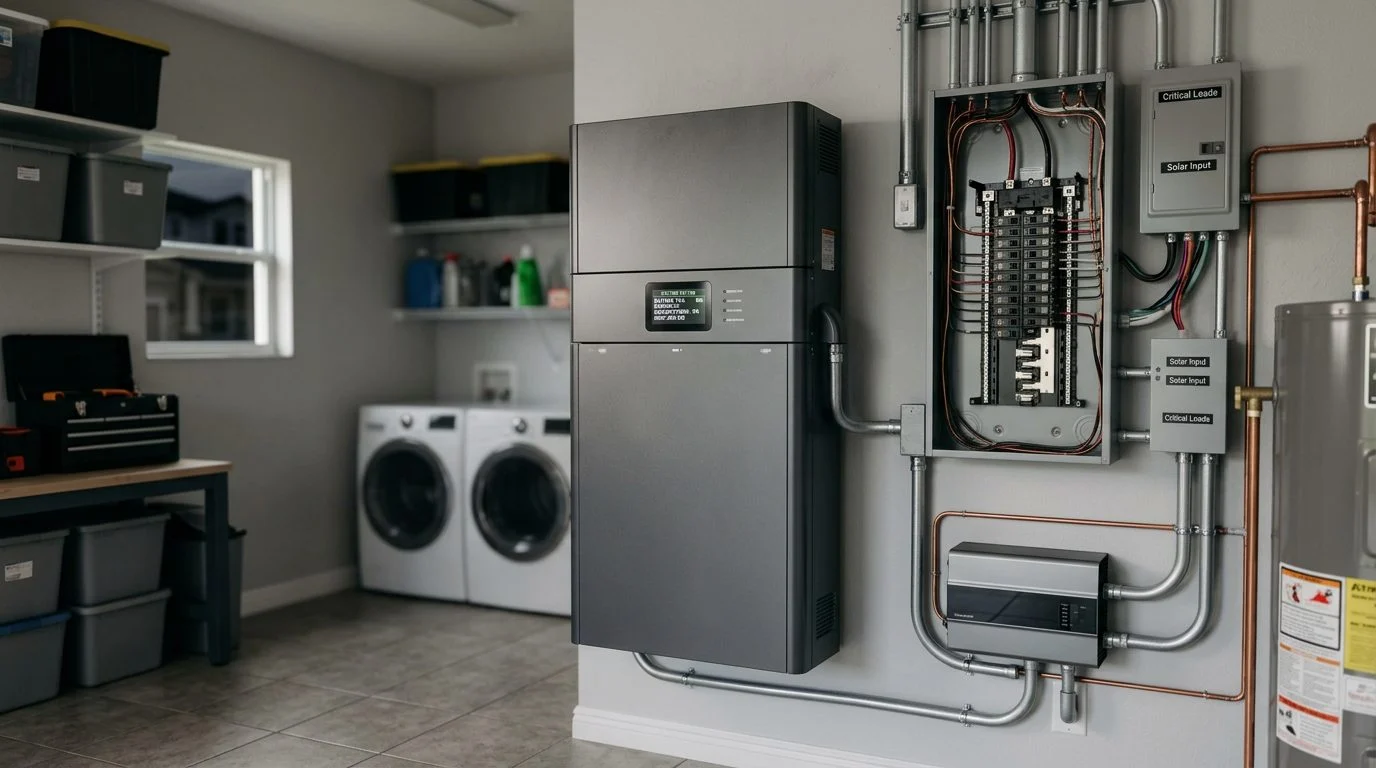
Solar batteries are typically installed in a garage, utility room, or outdoor weatherproof enclosure. The location must meet specific requirements:
- Ventilation: Lithium-ion batteries generate minimal heat, but the inverter does. Both need adequate airflow to prevent overheating.
- Temperature control: Ideally 50–85°F. Extreme heat or cold reduces battery efficiency and lifespan.
- Protection from moisture and salt spray: South Florida’s coastal environment means salt corrosion is a real concern. Outdoor enclosures must be rated for corrosive environments.
- Accessibility: The system needs to be accessible for monitoring, maintenance, and eventual replacement.
- Structural support: The battery and inverter weigh 100–300 pounds combined. Installation surfaces must be reinforced.
Electrical integration requires a licensed electrician to connect the battery system to your home’s electrical panel, solar inverter (if you have existing solar), and critical load circuits. This work requires permitting and inspection by your local municipality.
Safety features include automatic disconnects, arc-fault protection, and thermal monitoring. All equipment must meet Florida Building Code standards, including requirements for homes in High-Velocity Hurricane Zones (HVHZ). If your home is in an HVHZ, outdoor equipment enclosures must meet wind-load and installation standards to ensure they survive high winds.
Permitting and inspection vary by municipality but typically include electrical permits, structural review (if mounting on a roof or exterior wall), and final inspection before the system is activated. South Florida municipalities are familiar with solar and battery installations, but timelines can range from 2–8 weeks depending on local review capacity.
Cost, Incentives, and Financial Planning
A typical residential solar battery backup system costs $10,000–$25,000 installed, depending on battery capacity, inverter type, and installation complexity. This includes equipment, labor, permitting, and inspection.
Federal incentives: The Residential Clean Energy Credit covers 30% of the cost of battery storage systems installed with or after your solar panels. If you’re installing solar and battery together, you can claim 30% of the total cost (up to certain limits) as a federal tax credit. This credit applies to systems placed in service in 2024 and is scheduled to step down in future years.
To qualify, the battery must be paired with solar panels, and your home must be your primary residence or second home. The credit is nonrefundable, meaning it reduces your federal income tax liability but doesn’t generate a refund if the credit exceeds your tax liability.
Florida-specific incentives vary by utility and municipality. Some utilities offer rebates for energy storage or demand-response participation. Check with your local utility to see if programs are available in your area.
Financing options include cash purchase, home equity loans, solar loans, and lease or power-purchase agreements. Many solar installers offer financing with terms of 5–20 years, allowing you to spread the cost over time.
Payback timeline depends on your electricity rates, solar generation, and whether you use time-of-use rates or demand-response programs. In South Florida, where electricity rates are relatively high and solar generation is strong year-round, many homeowners see payback in 7–12 years. After that, the system generates savings for another decade or more.
Adding Battery Backup to an Existing Solar System
If you already have solar panels, you may be able to add battery backup—but compatibility depends on your current system design.
Grid-tied systems with a string inverter (the most common type) can often accept battery backup, but the inverter may need to be replaced with a hybrid inverter that manages both solar and battery. This upgrade typically costs $3,000–$6,000 and requires a licensed electrician and permitting.
Microinverter systems (where each panel has its own small inverter) are more challenging to retrofit. Battery addition usually requires replacing the microinverters and adding a separate battery inverter, which can be more expensive and complex.
Older systems (10+ years) may not be compatible with modern battery technology. An assessment by a qualified installer can determine whether retrofit is feasible and cost-effective.
The retrofit process typically takes 1–2 weeks from start to finish, including permitting, installation, and inspection. Costs are higher than adding battery to a new solar installation because of the inverter upgrade and system integration work.
Preparing Your Solar Battery Backup for Hurricane Season
South Florida’s hurricane season runs from June through November. If you rely on battery backup for resilience, preparation is critical.
Before hurricane season:
- Test your system in May to ensure the battery charges fully, the inverter switches properly, and all circuits operate as expected.
- Check ventilation and enclosure integrity. Ensure outdoor equipment is secure and won’t be damaged by high winds.
- Review your load management plan. Know which circuits are on battery backup and how to shed non-essential loads if needed.
- Update monitoring credentials. Ensure you can check your battery’s charge level remotely.
As a storm approaches:
- Charge your battery to 100% 24–48 hours before the storm arrives. This gives you maximum stored energy if the grid fails.
- Reduce unnecessary loads. Turn off pool pumps, hot tubs, and other non-essential equipment to preserve battery energy.
- Prepare for extended outages. If forecasts predict multi-day outages, plan to run AC only during the hottest parts of the day and use battery power strategically.
During and after the outage:
- Monitor your battery level via app or display. Adjust loads to avoid full discharge.
- Allow solar recharge during daylight. Even on cloudy days, panels generate some power. Don’t run unnecessary loads at night if you can defer them to daylight hours.
- Document outage duration and battery performance. This information helps you refine your resilience plan for future storms.
Real-World Performance: How Long Will Your Battery Last During an Outage
Battery runtime depends on four factors: battery capacity (kWh), home power demand (kW), weather (solar recharge potential), and load management.
Example scenarios for a typical South Florida home:
- 10 kWh battery, 2 kW average load, no solar recharge: ~5 hours of backup.
- 10 kWh battery, 2 kW average load, sunny day (solar recharges): Indefinite runtime; battery recharges during daylight.
- 15 kWh battery, 2 kW average load, cloudy day (minimal solar recharge): ~7–8 hours of backup.
- 20 kWh battery, 3 kW average load, sunny day: ~6–7 hours on stored energy; recharges during daylight for evening/night use.
Load shedding (turning off non-essential circuits) extends runtime dramatically. If you reduce load from 3 kW to 2 kW, you gain 33% more runtime. Prioritizing AC, refrigeration, and lighting while deferring pool pumps, electric ovens, and water heaters can double your effective backup duration.
Solar recharge is critical during extended outages. Even on a cloudy day, solar panels generate 10–25% of their rated output. On a sunny day, panels can generate 80%+ of rated output. A 5 kW solar array can generate 20–40 kWh on a sunny day, fully recharging a 10–15 kWh battery by mid-afternoon. This means that on sunny days, your battery can run your home indefinitely, cycling between discharge at night and recharge during the day.
Want to know where you stand?
Tell us what happened and our team will walk you through the options available to you, at no cost.
Next Steps: Getting Your Solar Battery Backup System Assessed
A professional assessment is the first step toward understanding what solar battery backup can do for your home.
During a consultation, expect:
- Home energy audit: A review of your electrical panel, appliance loads, and cooling system to estimate power demand.
- Solar potential assessment: If you don’t have solar yet, evaluation of your roof’s sun exposure, orientation, and shading.
- Battery sizing recommendation: A proposal for battery capacity, inverter type, and backup scope (essential loads vs. full home).
- Cost estimate: Itemized pricing for equipment, installation, permitting, and incentives.
- Timeline: How long from estimate to installation and activation.
Questions to ask:
- What size battery do you recommend, and why?
- How long will the battery run my home on a sunny day? On a cloudy day?
- Can you retrofit my existing solar system, or do I need a new installation?
- What’s included in the warranty, and what does it cover?
- Do you handle permitting and inspection, or is that my responsibility?
- Can I monitor my battery remotely, and what does the app show?
Timeline from estimate to activation typically ranges from 4–12 weeks, depending on permitting complexity, equipment availability, and your municipality’s inspection schedule. Most installations take 2–5 days of on-site work.
Frequently Asked Questions
How much does a solar battery backup system cost in South Florida?
A typical residential system costs $10,000–$25,000 installed, depending on battery capacity and complexity. The federal Residential Clean Energy Credit covers 30% of the cost if paired with solar panels.
Can I add battery backup to my existing solar panels?
Often yes, but it depends on your inverter type. String inverters can usually be upgraded to hybrid inverters; microinverter systems are more complex and costly to retrofit.
How long will the battery power my home during an outage?
Runtime depends on battery capacity, home load, and solar recharge. A typical 10–15 kWh system provides 5–8 hours on stored energy alone; on a sunny day, solar recharge extends runtime indefinitely.
Will the battery power my air conditioning?
Yes, but AC is the largest power consumer. Most systems can run one AC unit on battery; running multiple units simultaneously will drain the battery quickly. Load management (running AC during the day, reducing other loads) extends runtime.
What maintenance does a solar battery system require?
Lithium-ion systems require minimal maintenance: keep the area around the battery clean and dry, monitor the app for alerts, and have the system professionally inspected every 2–3 years.
Do I qualify for the federal tax credit?
Yes, if your battery is paired with solar panels and your home is your primary or secondary residence. The credit covers 30% of the system cost and is available for systems placed in service through 2032 (with the rate stepping down after 2032).
How do I prepare my battery for hurricane season?
Charge the battery to 100% 24–48 hours before a storm, review your load management plan, and ensure your outdoor equipment is secure. Test the system in May to confirm everything works.
If you’re facing repeated outages or want to protect your home through hurricane season, a solar battery backup assessment can show you exactly what’s possible—reach out to discuss your home’s needs.
Why Add Battery Backup to Your Solar System
Energy Independence
Store the solar energy your panels generate and use it when you need it most—day or night, even during outages.
Outage Protection
South Florida's hurricane season and grid disruptions are unpredictable. Battery backup keeps essential systems running when power fails.
Lower Energy Bills
Use stored solar power during peak-rate hours to reduce what you draw from the grid and cut your monthly costs.
Seamless Switching
Modern battery systems detect outages instantly and switch to backup power automatically—no manual intervention needed.
How Solar Battery Backup Works
Solar Panels Generate Power
Your rooftop panels convert sunlight into electricity throughout the day, with excess energy flowing to the battery.
Battery Stores the Energy
The battery system captures and stores that solar energy in a rechargeable unit, ready to power your home anytime.
Smart System Manages Flow
Intelligent controls optimize when you use stored power, pull from the grid, or draw from solar in real time.
Automatic Backup During Outages
If the grid goes down, your battery seamlessly takes over to keep lights, AC, refrigeration, and other essentials running.
Federal Tax Credit Available
The federal Residential Clean Energy Credit covers 30% of the cost of a solar battery backup system when installed alongside solar panels. This incentive can significantly reduce your out-of-pocket investment.
Common Questions About Solar Battery Backup
How much does a solar battery backup system cost?
A typical residential system costs $10,000–$25,000 installed, depending on battery capacity and system complexity. The federal tax credit can cover 30% of the cost when paired with solar panels.
Can I add battery backup to my existing solar panels?
Often yes, but it depends on your inverter type and system design. ASP Superhome will evaluate your current setup and recommend the best retrofit approach for your home.
How long does a battery last during an outage?
Runtime depends on battery capacity and your home's power usage. A typical system can power essential loads (lights, refrigerator, AC, water pump) for several hours to a full day or more.
What maintenance does a battery system need?
Modern lithium battery systems require minimal maintenance. ASP Superhome handles system monitoring and any necessary service to keep your battery performing reliably.
Why Choose ASP Superhome for Solar Battery Backup
Complete System Design
We assess your home's power needs, solar production, and outage patterns to design a battery system sized right for your situation.
Professional Installation
Our team handles all electrical work, permitting, and integration with your existing solar panels or new installation.
South Florida Focused
We understand the unique challenges of Miami, Fort Lauderdale, West Palm Beach, and surrounding areas—hurricane season, heat, and grid reliability.
Transparent Guidance
We explain your options, costs, incentives, and expected performance so you can make a confident decision.


