


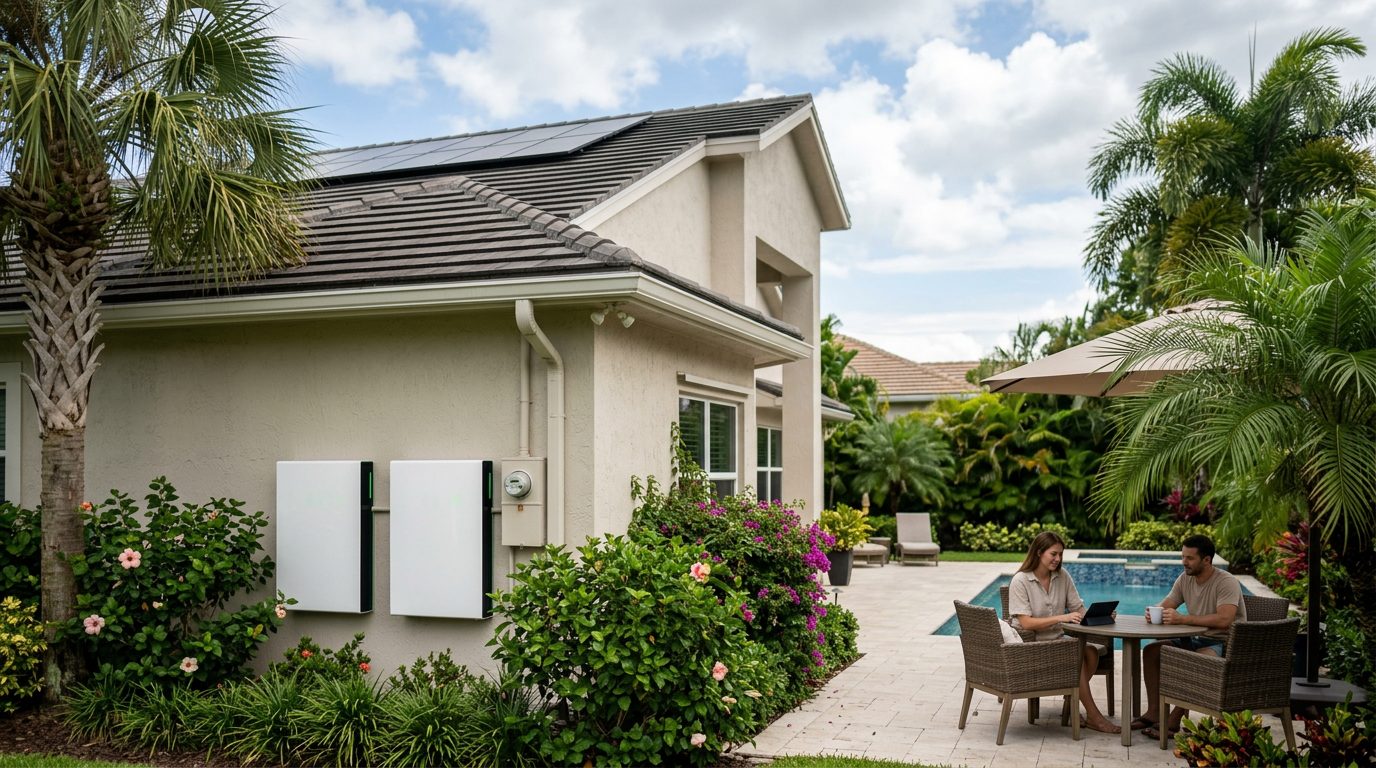
Solar battery backup | South Florida
How Long Will Your Battery Keep the Lights On?
Backup time depends on what your home is running, not just the size of the battery. Here is how to think about it before a storm or outage.
By Jonathan Rodriguez · Published November 8, 2026
If the power just went out, you probably want one number: how long will a 13.5 kWh battery last? The short answer is that runtime depends on how much power your home draws at once.
A 13.5 kWh battery supplies about 13.5 hours at a steady 1 kW load. Most homes draw more than that, so the real number is often shorter. This guide shows the math, the loads that drain a battery fastest, and what changes the result for South Florida homes.
The Short Answer: How Long a 13.5 kWh Battery Lasts
Runtime equals the battery’s energy divided by the average power your home draws during an outage. At a steady 1 kW load, a 13.5 kWh battery runs about 13.5 hours. At 2 kW, it runs about 6.75 hours.
The 13.5 kWh figure is the commonly listed capacity for this battery size. Usable energy can differ a little from the nominal rating, so treat the division as an estimate.
Real households rarely draw a steady load. A refrigerator cycles on and off, lights switch on and off, and an air conditioner can run for long stretches. The appliances running at that moment matter more than the headline capacity.
If a recent storm has you wondering whether a battery would keep your fridge and AC running, we can talk through your home's numbers with you. Talk it through with our team — the first consultation is free, confidential, and carries no obligation.
How the Runtime Calculation Works
Three steps give you a usable estimate. Find the usable storage, find the average load, then divide. Storage is measured in kilowatt-hours (kWh). Load is measured in kilowatts (kW).
Here is a moderate example. Suppose your home averages 1.5 kW during an outage. That covers the refrigerator, some lights, Wi-Fi, and a few fans. Then 13.5 divided by 1.5 gives 9 hours.
Here is a heavier example. Suppose the average climbs to 4 kW because central air conditioning runs alongside the refrigerator and a water heater. Then 13.5 divided by 4 gives about 3.4 hours. Same battery, very different result.
A kilowatt measures a rate of use, like speed on a road. A kilowatt-hour measures a total amount, like miles driven. Once you know both, you can check any battery spec against your own numbers.
Conversion losses matter too. Solar and battery systems convert electricity between DC and AC, and that conversion wastes some energy as heat. Real runtime usually lands a bit shorter than the simple division suggests.
What Average Household Energy Use Looks Like
Your monthly electric bill is the best place to find your average daily use. Divide the total kWh for the billing period by the number of days in that period.
For example, a home that used 900 kWh over 30 days averages 30 kWh per day. Spread across 24 hours, that’s an average load of 1.25 kW. A 13.5 kWh battery would cover that steady load for nearly 11 hours.
Check your summer bills. Florida homes typically use more electricity in warm months because air conditioning runs for long hours. A winter bill can understate what your home needs during a summer heat wave or storm outage.
A daily average also hides peaks. Afternoon air conditioning, cooking, and a pool pump can pull much harder than the average suggests. Those peaks drain a battery faster than the daily total would indicate.
Which Appliances Drain the Battery Fastest
Central air conditioning and electric water heating drain a battery fastest. Both draw a lot of power while they run, and both can run for long stretches.
Electric ranges and ovens, clothes dryers, pool pumps, and well pumps are also heavy loads. Running several high-draw appliances at once shortens runtime far more than running one. That’s why load planning matters.
A refrigerator and freezer cycle on and off. Their start-up draw is higher than their average draw, so their average load is much lower than the peak. They still matter, because they run around the clock.
Lighting, Wi-Fi equipment, phone chargers, and televisions are low-draw loads. Each one adds little, but they add up over many hours.
Roofing affects air conditioning too. The EPA’s guidance on cool roofs says reflective, light- or cool-colored metal roofing can reduce solar heat transfer, indoor temperatures, and air-conditioning energy use, including in warm climates. A cooler roof means the AC works less, which helps the battery last longer.
Factors That Change How Long the Battery Runs
Several factors shift the result, and you can plan for most of them.
Charge at the start matters most. A battery that was full at sunset runs longer than one that was partly drained by earlier use or an earlier outage.
The backup reserve setting also matters. A higher reserve keeps more energy in the battery for emergencies, which leaves less for everyday use. A lower reserve gives more runtime but less cushion.
Weather affects recharging. Cloudy days and afternoon storms cut solar output, and South Florida’s rainy season brings plenty of both. A battery that relies on sunshine recharges more slowly in that season.
Battery age matters over time. Capacity can decline gradually over the years, so runtime may shrink. Plan for that rather than assuming the first-day number holds forever.
Load management is the last lever. Choosing which circuits stay on during an outage decides how long the battery supports your household.
How Solar Panels Change the Answer
Without solar, a 13.5 kWh battery is a finite supply. It runs down and must be recharged from the grid. Once the stored energy is gone, the backup ends.
With solar panels, daytime production can recharge the battery each day. That can extend how long your household relies on stored energy during a longer outage. Whether your system keeps running during an outage depends on how it is wired.
Solar recharging depends on sunlight. Runtime across a multi-day outage tracks the weather closely. A sunny stretch helps a lot, while a week of storms helps very little.
Florida’s net metering rule adds another layer. Under Fla. Admin. Code R. 25-6.065, energy credits produced from excess customer-owned renewable generation delivered to the utility’s electric grid accumulate and offset your usage in later months for a period of not more than twelve months, and at the end of each calendar year the utility pays you for any unused energy credits at an average annual rate based on its COG-1, as-available energy tariff. The rule applies to investor-owned utilities. It covers grid billing, not outage runtime, so keep the two separate.
Battery size is the other lever. More capacity means more backup time. A single 13.5 kWh unit is one option among several sizes, and the right choice depends on your loads.
Not sure what your next step is?
Talk it through with our team — the first consultation is free, confidential, and carries no obligation.
Practical Ways to Stretch Battery Backup Time
A backup-only circuit is the most useful step for most homes. It gives essential loads, such as the refrigerator, lights, and internet, priority during an outage.
Limit high-draw appliances while the battery is running. Skip the oven, the dryer, and multiple AC units running at the same time. Keeping those loads off helps the battery support essentials for longer.
Adjust the reserve and check the state of charge in the monitoring app. That shows how much runtime remains, so you can change habits before the battery runs low.
Plan before the outage. Keep the battery charged, and review which circuits are covered while the lights are still on. Hurricane season is a good time to do this review.
Windows and doors also affect cooling load. ENERGY STAR certifies residential windows, doors, and skylights for energy-efficiency performance, which gives you one way to compare products.
Safety matters as well. UL Solutions reports on lithium-ion battery and energy-storage incidents, including injuries and fatalities, and notes the limits of available safety data. Treat battery placement and installation as serious decisions.

Talk Through Your Home’s Numbers With Our Team
If a recent outage has you wondering whether a battery would keep the fridge and an air conditioner running, you’re not alone in asking. You may be researching this for a parent, a landlord, or a family member, and the decision carries real weight.
The math on this page is a starting point. Your bills, your circuits, and your goals shape the right setup for your home.
How many hours does a 13.5 kWh battery power a house?
Runtime depends on the average load. At a steady 1 kW, it lasts about 13.5 hours; at 4 kW, about 3.4 hours.
Can a 13.5 kWh battery run central air conditioning?
It can, but central air draws a lot of power, so runtime drops quickly. Running the AC alongside the refrigerator shortens the backup considerably.
Does solar recharge the battery during an outage?
It can, when the system is set up to run during an outage and enough sunlight reaches the panels.
When you’re ready to see how your home’s numbers work, book a free first consultation. It’s confidential and comes with no obligation to continue.
Planning your backup with ASP Superhome
Start with your real loads
We look at which appliances and systems you want powered during an outage, so the backup plan matches how your home actually uses electricity.
Built around South Florida conditions
Heat, humidity, and storm season all affect how a home uses power. Our team factors those conditions into the recommendation.
Solar and backup as one plan
ASP Superhome handles solar panels, solar battery backup, roofing, and impact windows and doors, so the pieces of your home work together.
A free first consultation
Your first consultation is free, confidential, and comes with no obligation to continue.
Tip before you size a battery
List the appliances you expect to run during an outage and note which ones cycle on and off. A battery that looks adequate on paper can run short once air conditioning and other high-draw loads are included.
What changes how long your battery lasts
Which loads you run
Cooling, refrigeration, water heating, and cooking draw very different amounts of power, and they add up quickly.
How hot it is
Long stretches of heat mean more cooling, and that steady demand can shorten backup time.
How your solar panels charge the battery
Sunny days can recharge the battery during an outage, while cloudy or stormy stretches may leave it lower.
How the system is set up
The battery's capacity, the inverter, and which circuits are backed up all determine what it can power.
Get a clear picture of your home's backup needs. Book your free, confidential first consultation with no obligation to continue.
Related practice areas
- Roof Structural Check for a Solar Battery in Florida


