


Solar Battery Backup | South Florida
Keep the Lights On During a South Florida Hurricane Outage
See how long a solar battery can power your home when the grid goes down, and what determines those hours. ASP Superhome can help you plan a backup system for Miami, Fort Lauderdale, West Palm Beach, Kendall, Naples, Fort Myers and Boca Raton.
By Jonathan Rodriguez · Published November 8, 2026
How Many Hours Will a Solar Battery Power My Home in a Hurricane Outage?
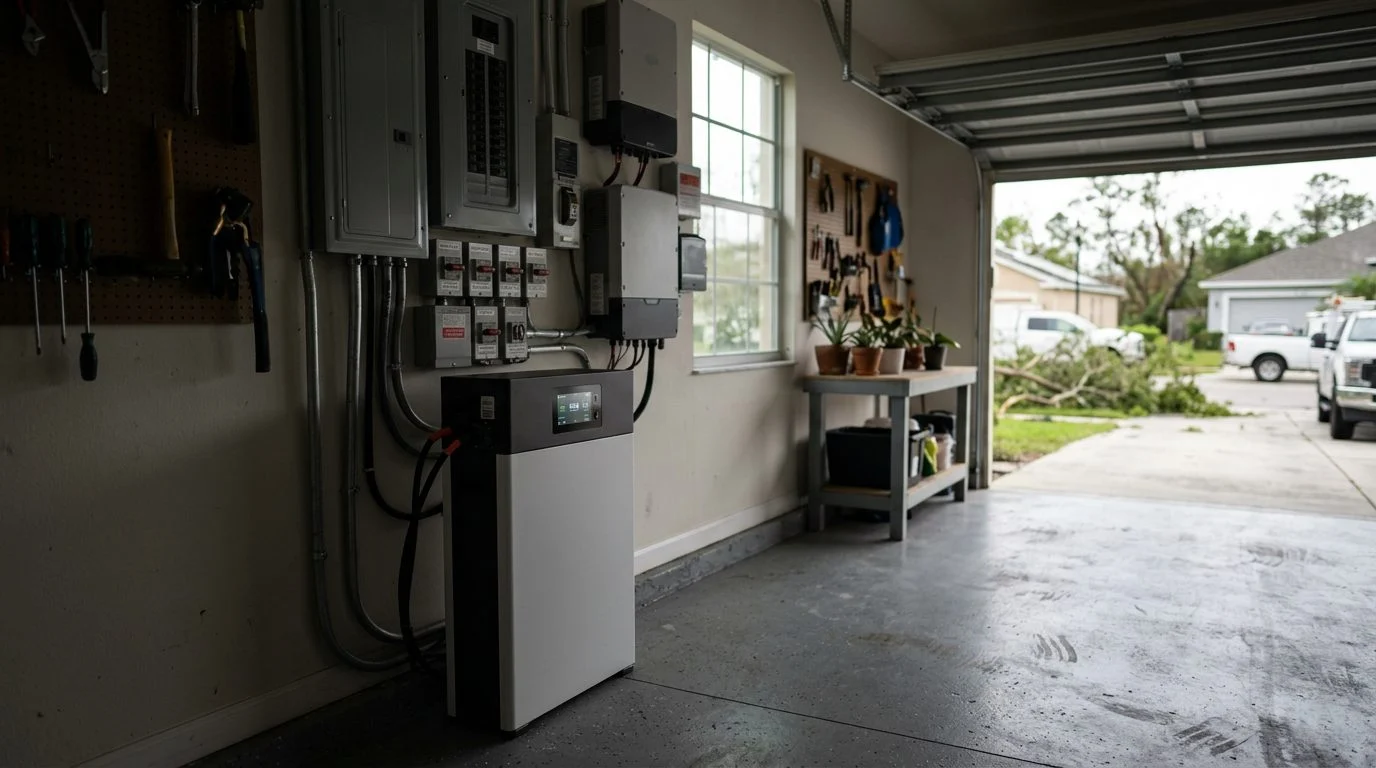
A solar battery powers your home for about its usable kilowatt-hours (kWh) divided by your average power draw in kilowatts (kW). A 13.5 kWh battery running a steady 1.5 kW load lasts about 9 hours. If you’re asking how many hours will a solar battery power my home during a hurricane outage, that formula is the place to start.
If you’re reading this with a storm forecast on your screen, or after an outage has already begun, you’re not alone. Many people are planning for a parent, a neighbor, or a household that relies on medical equipment. This page explains the math and the factors that change the result.
If you're working out what a battery could cover before storm season, our team can walk through your home's numbers with you. Talk it through with our team — the first consultation is free, confidential, and carries no obligation.
The short answer: how runtime is calculated
Runtime equals usable energy divided by average power draw. In plain terms, hours = usable kWh ÷ average kW. The size printed on the battery doesn’t tell you the hours by itself.
Usable capacity is often lower than the nameplate number. The spec sheet lists how much energy you can actually draw, so check that figure before you compare batteries.
Here’s an illustrative example. A battery with 13.5 kWh usable, supplying a steady 1.5 kW average draw, runs about 9 hours. Real homes vary, so treat this as a teaching example, not a forecast for your house.
Why the same battery gives different hours at different homes
Household load is the biggest variable. LED lights, a refrigerator, a router, and ceiling fans draw far less power than central air conditioning, an electric water heater, or an electric range. A battery that runs a fridge for a day may run central air for only a few hours.
Critical-load setup is the second lever. A system wired to back up only selected circuits runs longer than one trying to carry the whole house. Most people pick the circuits they truly need, such as the refrigerator, a few lights, the internet router, and medical equipment.
State of charge matters too. A battery that starts an outage full has more hours than one that starts low after several cloudy days. A storm that arrives after a full charge plays out differently from one that hits after a rainy stretch.
Daytime solar input can add energy once the storm passes and the sun returns. Heavy cloud cover, or debris on the panels, can cut that input. Plan for the weak-sun case, not the best day.
Can I use my solar panels when the power is out?
Solar Energy Technologies Office notes that panels make power only when the sun shines, and a battery stores that power for later. Whether your panels can keep your home supplied during an outage depends on how the system is built. A battery with a backup-capable inverter can keep selected loads running during an outage. Systems without that setup may not do so. Our [solar battery backup overview for South Florida homes] can explain which setup fits your home.
Florida’s interconnection rule also shapes what happens during grid trouble. Under Florida Rule 25-6.065, an investor-owned utility may open a manual disconnect switch pursuant to the conditions set forth in paragraph (6)(c) and isolate your renewable generation. Rule 25-6.065 applies to all investor-owned utilities, except as otherwise stated in subsection (10). Under Fla. Admin. Code R. 25-6.065, an investor-owned utility may open the switch pursuant to the conditions set forth in paragraph (6)(c) and isolate customer-owned renewable generation without prior notice to the customer; to the extent practicable, however, prior notice shall be given. If prior notice is not given, the utility shall at the time of disconnection leave a door hanger notifying the customer that their customer-owned renewable generation has been disconnected, including an explanation of the condition necessitating such action. The investor-owned utility shall reconnect the customer-owned renewable generation as soon as the condition necessitating disconnection is remedied.
For a deeper look at how older battery setups differ in an outage, see our guide on solar batteries without an enhanced backup inverter.
How long does a 40 kWh battery last?
A 40 kWh usable battery at a 2 kW average draw runs about 20 hours. At a 4 kW average draw, it runs about 10 hours. These are illustrations of the formula, not promises.
A larger battery adds hours mainly when your average draw stays low. Sizing depends on how your household uses power day to day.
South Florida summers are the common trap. Central air conditioning can pull several kilowatts for long stretches. A large battery can drain faster than expected if the AC runs through a multi-day outage. Count the AC as its own load when you do the math.
Why hurricane outages can last longer than one night
Hurricane outages can stretch for days. Downed lines, flooding, and damaged equipment all take time to repair. Storm damage in each service area sets the timeline, so no one can count on a fixed restoration window.
Plan for the longer scenario. A battery that covers essential loads for one day may not last a week without solar recharging it. Cloudy days after a storm slow that recharge. Knowing this ahead of time helps you decide which loads to shed first, such as the water heater and the AC, and which to keep.
Not sure what your next step is?
Talk it through with our team — the first consultation is free, confidential, and carries no obligation.
Solar battery or generator: which is the better backup in a hurricane?
A solar battery needs no fuel deliveries, runs quietly, and produces no engine exhaust. A generator keeps running as long as it has fuel, so it can help in very long outages if you can get fuel to it. Generators must run outdoors, away from doors and windows.
Many homeowners weigh both options. The better fit depends on your essential loads, your storage space, and how easily you can get fuel after a storm. Compare runtime in hours, the fuel supply, and how much you need to back up.
How to estimate your own home’s runtime
Start by listing the circuits and devices you want running during an outage. Typical choices include the refrigerator, lights, internet router, fans, and any medical equipment.
- Read each device’s wattage from its label. Multiply watts by hours per day, then divide by 1,000 to get daily kWh.
- Add the daily kWh for all essential loads. Divide that total by 24 to get your average kW.
- Divide your battery’s usable kWh by that average kW. The result is your estimated hours.
For example, if your essential loads total 24 kWh per day, your average draw is 1 kW. A 13.5 kWh usable battery then covers about 13.5 hours.
Installation rules also matter. The same analysis adds garage impact-protection rules, as described in the Florida Building Commission analysis. Contact our team to review what these rules mean for your project during a free initial consultation, which is confidential and carries no obligation.
Talk through your home’s numbers with our team
If you’d like your numbers checked, our team can help. Share your essential loads and your battery questions, and we’ll work through the math for your house.
Our first consultation is free, confidential, and carries no obligation to continue. You can request a quote when you’re ready.
How many hours will a solar battery power my home during a hurricane outage?
Runtime is usable kWh divided by your average kW draw. A 13.5 kWh battery at 1.5 kW lasts about 9 hours, though real homes vary.
Can I use my solar panels when the power is out?
Only if the system is built to back up your home. A battery with a backup-capable inverter is the key part of that setup.
How long does a 40 kWh battery last?
At a 2 kW average draw, about 20 hours. At 4 kW, about 10 hours. These are illustrations, not guarantees.
Is a solar battery better than a generator in a hurricane?
Each has strengths. A battery needs no fuel, while a generator runs as long as it has fuel.
What Shapes Your Battery Hours
Battery Capacity
The usable kilowatt-hours (kWh) your battery stores set the upper limit on how long it can run.
Your Power Draw
Running the refrigerator, fans and well pump uses far less energy than air conditioning, so the appliances you power decide how fast the battery drains.
Backup-Capable Equipment
Your inverter and wiring must be designed to isolate your home from the grid during an outage. Without that setup, the battery may not power your home at all.
Charge Before the Storm
A battery that starts a storm fully charged gives you more hours than one that is partly drained when the power fails.
Plan Before Hurricane Season
A battery sized for lights and essentials may not carry central air conditioning through a multi-day outage. Ask us to review your loads and your system design before you rely on backup power.
Ways to Extend Backup Power
Prioritize Essential Circuits
Wire the circuits you need most, such as refrigeration, lighting, communications and medical equipment, to the backed-up side of your system.
Reduce Peak Loads
Limit high-draw appliances during an outage and stagger their use to stretch stored energy further.
Pair Solar With Storage
Solar panels can recharge the battery on sunny days, extending runtime during longer outages.
Pair Roofing and Solar Work
Our team can coordinate roof repair or replacement alongside solar installation, so your roof and power system are planned together.


