


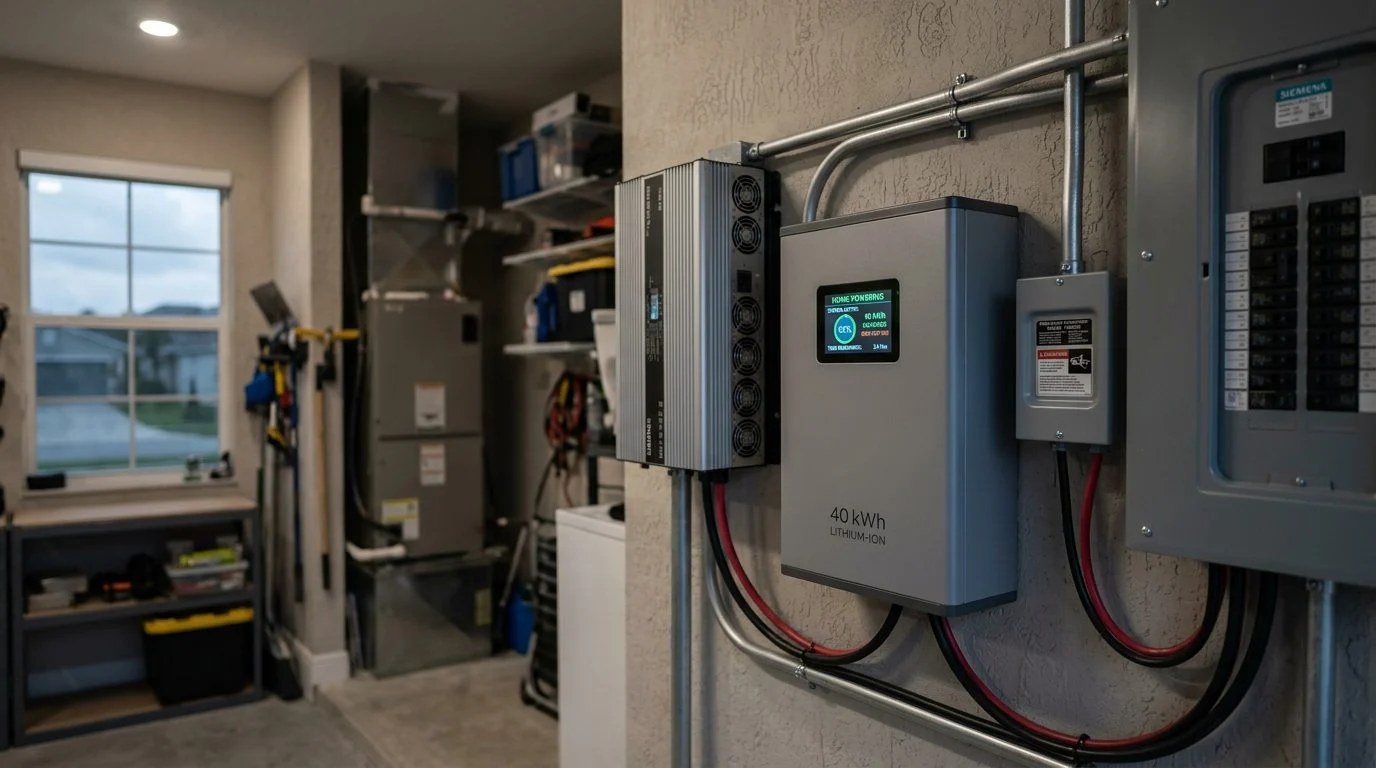
Solar Battery Backup | South Florida
How Long Does a 40 kWh Battery Last in Your South Florida Home?
Runtime depends on how much power your home draws. Here is how to estimate it for your load, your solar setup and your climate.
By Jonathan Rodriguez · Published November 8, 2026
How long does a 40 kWh battery last? The honest answer has two parts. It can power your home for a set number of hours during an outage. It can also hold up for a set number of years before it wears out. For most South Florida homes, the hours depend on what runs at the same time. The years depend on how the battery is used and cared for. This guide shows you how to work out both for your own home.
What a 40 kWh Battery Stores and What “Lasting” Means
A 40 kWh battery holds 40 kilowatt-hours of energy. That is its rated capacity. One kilowatt-hour (kWh) is one kilowatt of power used for one hour. Think of the rating as the size of a fuel tank. It tells you how much energy is stored, not how fast it empties.
“Lasting” means two different things. Runtime is how long the stored energy keeps your home powered during an outage. Service life is how many years the battery keeps working. Keep these apart, and the rest of this guide makes sense.
Not all rated energy is available. Many batteries limit how far they discharge, which protects the battery but leaves a reserve you can’t use. So the usable kWh is often lower than the 40 on the label. For background on how storage works, the U.S. Department of Energy solar office covers energy storage and battery backup basics.
Kilowatts (kW) are different. A kW measures power, meaning how fast energy flows at one moment. A battery can store 40 kWh but deliver only so many kW at once. That limit comes from the inverter, which we explain below.
If an outage or a coming storm season has you working through these numbers, we'd be glad to talk through your home's load with you. Talk it through with our team — the first consultation is free, confidential, and carries no obligation.
How to Estimate How Long a 40 kWh Battery Will Run Your Home
Runtime in hours equals usable battery energy in kWh divided by your average load in kW. That one formula answers most runtime questions.
Here’s a worked example. Assume 36 kWh is usable. That number is for illustration only.
- Small steady load, 1 kW: a few lights, a refrigerator, and internet equipment. 36 ÷ 1 = 36 hours, about a day and a half.
- Larger steady load, 5 kW: central air plus a water heater and kitchen appliances running together. 36 ÷ 5 = 7.2 hours.
You can find your own average load on your electric bill. Your monthly kWh total is printed there. Divide it by 30 to get daily kWh. Then divide by 24 to get average kW. For example, 900 kWh a month equals 30 kWh a day, or 1.25 kW on average. At 36 usable kWh, that’s about 29 hours at that average.
Outage runtime isn’t just the monthly average. Your bill averages every hour of the month. An outage hits at one specific hour, with whatever is running then. A hot afternoon with the AC and pool pump on draws far more than the average. Plan for what runs during the outage.
Which Appliances Drain a 40 kWh Battery Fastest
Central air conditioning, electric water heaters, electric ranges, pool pumps, well pumps, and EV chargers drain a battery fastest. In South Florida, air conditioning is often the largest draw. Cooling can run for many hours on hot days.
Motors and compressors also add a short surge. When an AC compressor or pump motor starts, it pulls more power for a moment than it needs while running. The surge is brief. It still counts against the inverter’s limit, and it can overload a system sized too tightly.
An EV charger is a steady, heavy load. It draws power for as long as it charges. Running it during an outage can shorten runtime fast.
Your circuit choice matters a lot. Backing up the whole house means the battery feeds every circuit, so runtime shrinks. Backing up essential circuits, such as lights, the fridge, and internet, keeps the load low and the runtime longer.
The inverter sets how much power flows at one time. Even a large battery can’t deliver more power than its inverter allows. That is why the kW rating matters as much as the kWh rating.
How Long a 40 kWh Battery Lasts Before It Needs Replacement
Service life is the number of years a battery keeps doing its job. It depends on use, heat, and care. Battery chemistry matters too. UL Solutions notes that battery technologies differ in energy density, lifespan, and safety characteristics.
Each full charge and discharge counts as a cycle. Batteries are rated by how many cycles they can handle. Daily solar charging and regular outage use add cycles over time. Deeper discharges generally add more wear than shallow ones.
Heat is a planning factor in South Florida. Heat and humidity affect how a battery runs. Installation location and ventilation change the operating conditions, so plan for them from the start.
When you compare expected service life, look at two terms in the model’s documents. Check the warranty period and the cycle or throughput limits stated for that model. Those terms tell you more than a generic year count.
Expected lifespan depends on the specific system and how it’s used. Two identical batteries can age differently in two different homes.
Is a 40 kWh Battery Enough to Run a Whole House?
Whether 40 kWh is enough depends on your daily use and which circuits the battery supports. A battery that covers essential circuits can often carry a home through short outages. Whole-house use with heavy AC needs more energy or solar recharge.
Solar panels change the math. During daylight, panels recharge the battery. That can stretch stored energy across several days, as long as the system is sized to your load.
Both ratings must fit the home. The kWh rating sets how much energy you store. The inverter’s kW rating sets how much power you can draw at once.
How long does a 40 kWh battery last?
Runtime depends on load. At a steady 1 kW, 36 usable kWh lasts about a day and a half. Service life is separate and depends on use and care.
Is a 40 kWh battery enough?
It can be, for essential circuits. For whole-home use with central air, it may run out within a day without solar recharge.
Is a 20 kW battery enough to run a house?
A 20 kW rating describes power, not stored energy. Ask how many kWh the battery stores, too.
What Drives the Cost of a 40 kWh Battery System
Battery capacity, inverter size, electrical work, permits, and your electrical panel drive most of the cost. A system sized to essential loads costs differently from one sized to the whole home. The right figure depends on your home and system design.
Permits are part of your timeline. Under Florida Statute § 553.79, a building permit for a single-family dwelling expires one year after issuance or on the effective date of the next Florida Building Code edition, whichever is later. A local government may extend it. Under Fla. Stat. § 553.79, each local building authority is required to publish online the procedures it follows to process, review, and approve the permit applications it receives.
Battery location also matters.
Not sure what your next step is?
Talk it through with our team — the first consultation is free, confidential, and carries no obligation.
Talk Through Your Home’s Numbers With ASP Superhome
You may be reading this during an outage, after a storm, or while a family member’s needs weigh on the decision. These questions are hard to sort out alone, especially with a power bill in hand.
Bring three things to the conversation: your electricity bill, the appliances you most need to keep running, and your outage concerns. With those, ASP Superhome can help you plan for your home’s load. The first consultation is free, confidential, and carries no obligation to continue (Spanish: consulta inicial gratuita, confidencial y sin compromiso). You can reach out to ASP Superhome here.
For more planning detail, read our solar battery backup guide for South Florida.
How ASP Superhome Helps You Plan
Load review
We look at which circuits you want backed up and how much power they typically draw, so the runtime estimate reflects your actual home.
Solar and battery together
We can review your battery backup alongside solar panels, so you can see how daytime recharging fits into your plan.
Clear, plain answers
We explain the numbers in everyday terms and answer your questions before you decide on anything.
Confidential first consultation
Our free first consultation is confidential and comes with no obligation to continue.
Size for the circuits you actually need
A 40 kWh battery can run essential circuits for a long time, but whole-home use with central air conditioning can drain it within a day if the sun is not recharging it. Estimate your daily use before you assume a runtime.
What Changes Your Battery Runtime
Power draw
Runtime is roughly usable kWh divided by the average kW your home pulls. A steady 1 kW load stretches the battery far longer than a home running central air and appliances at once.
Usable capacity
The full 40 kWh rating is not all available for use. Usable capacity is what matters when you estimate how long the battery will support your home.
Solar recharging
On sunny days, solar panels can refill the battery during the day, which can extend how long your home runs on stored power over several days.
Battery age and care
Service life depends on how the battery is used and maintained over the years, so it is worth planning for both runtime and long-term performance.


