


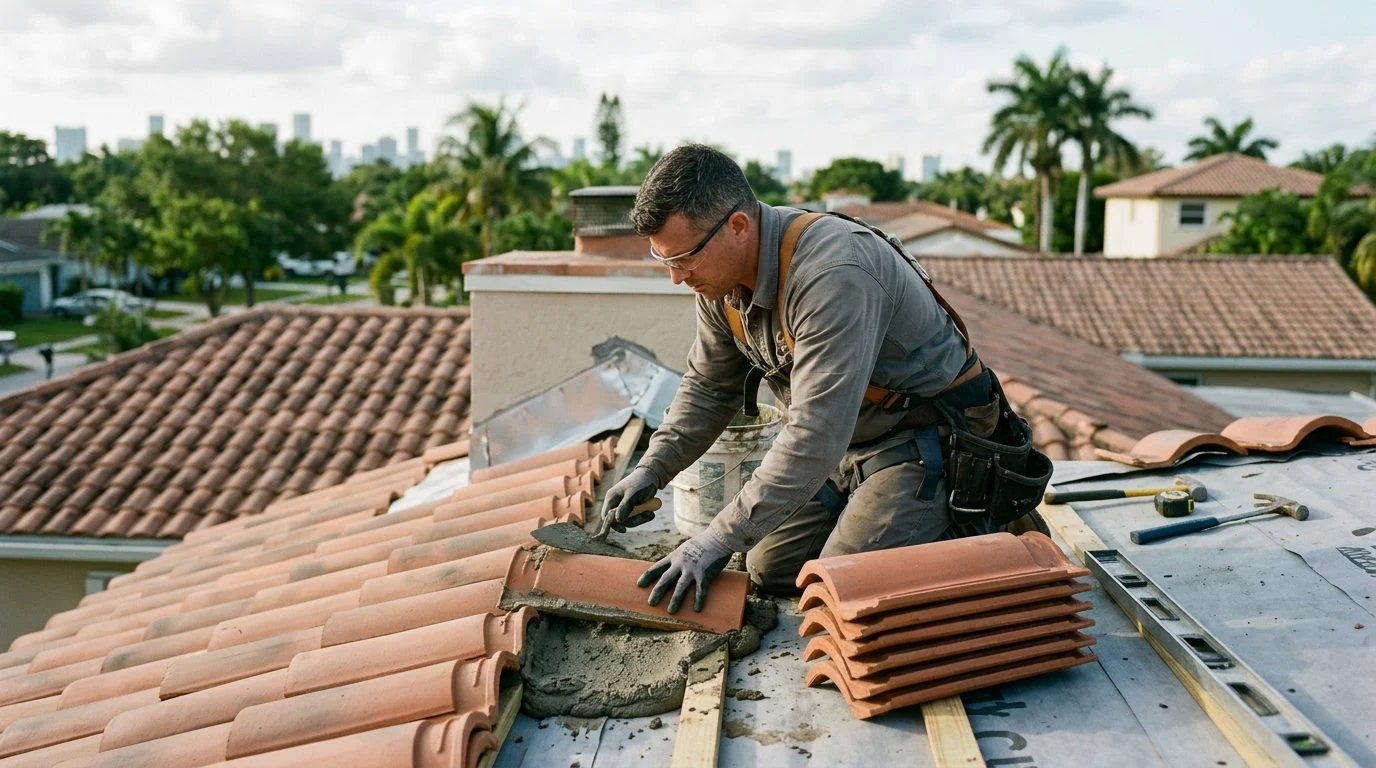
Tile Roof Installation | Miami-Dade
Wind-Rated Tile Roofs Built for South Florida Storms
ASP Superhome installs tile roofs in Miami-Dade with a focus on wind-rated fastening, sound decking, and a clear, written estimate. Start with a free first consultation.
By Jonathan Rodriguez · Published October 21, 2026
A tile roof installation in Miami-Dade has to meet wind rules that cover the whole roof, not just the tiles. This guide explains which rules apply, what a wind-rated installation includes, and how the job moves from first visit to final inspection. Our team reviews your roof and property with you before any work starts.
Who needs a wind-rated tile roof in Miami-Dade and Broward?
A wind-rated tile roof is a complete roof system approved for the wind conditions of the property. It includes the tile, underlayment, fasteners, flashing, and attachment method. Most owners who need one fall into three groups: owners replacing an aging tile roof, owners building new, and owners whose permit or insurance paperwork asks for documented wind-rated construction.
Florida law adds rules for some existing buildings. Under Fla. Stat. § 553.844, for site-built, single-family residential structures, a roof replacement must incorporate specified wind-mitigation techniques. For a building in the wind-borne debris region with an insured value of $300,000 or more (or, if the building is uninsured or lacks documentation of insured value, a just valuation for ad valorem taxation of $300,000 or more), the roof-to-wall connections described in subparagraph (2)(b)3. also apply. However, those connections are not required unless evaluation and installation of connections at gable ends or all corners can be completed for 15 percent of the cost of roof replacement. The listed techniques also cover gable-end bracing, roof-to-wall connections, strengthening or correcting roof-decking attachments and fasteners during reroofing, and adding or strengthening opening protections, among others. Ask about this early, because it can change the scope and cost of the job.
If your tile roof is past its useful life or your Miami-Dade permit now asks for wind-rated paperwork, our team can review it with you. Talk it through with our team — the first consultation is free, confidential, and carries no obligation.

HVHZ rules and product approval in Miami-Dade
The Miami-Dade 2023 Florida Building Code roofing changes cover those requirements.
Roofing products requiring approval under § 553.77 must be approved before use in construction in Florida. Under Florida law, a product may not be advertised, sold, offered, provided, distributed, or marketed as hurricane, windstorm, or impact protection from wind-borne debris unless it is approved under Fla. Stat. § 553.842 or s. 553.8425, and anyone who does so without that approval is subject to the Florida Deceptive and Unfair Trade Practices Act.
A Miami-Dade Notice of Acceptance shows that a product was tested and accepted for compliance with the Florida Building Code, including Miami-Dade and HVHZ requirements.
Approval has limits. Under Fla. Stat. § 553.8425, an approval stays valid until the product changes and decreases in performance, the code requires increased performance, or the approval is suspended or revoked. Changes to the code do not void the approval of products previously installed in existing buildings if such products met building code requirements at the time the product was installed. A substitute tile or a different nail pattern can fall outside the approval.
Florida also requires a permit before a building is repaired or altered. Under Fla. Stat. § 553.79, unless otherwise provided by law, doing that work without a permit is unlawful; for example, work valued under $7,500 on a single-family owner’s property is exempt from the permit requirement, but the exemption does not apply to work on a property that is partially or entirely located in a flood hazard area as defined by the Florida Building Code. Our team prepares the permit file, including the product approval documents, before work begins.
What a wind-rated tile installation includes
A complete installation covers the deck, underlayment, tile fastening, flashing, ventilation, and edge metal. The Tile Roofing Industry Alliance installation guides cover installation practices and acceptable high-wind products and processes in Florida.
- Tear-off and deck inspection. Damaged decking is repaired before new layers go down.
- Underlayment. The secondary water barrier and underlayment match the approved system.
- Tile attachment. Fasteners follow the approved schedule at edges, ridges, and eaves.
- Flashing and penetrations. Metal flashing at valleys, walls, vents, and chimneys is sealed to the approved detail.
- Ventilation. Intake and exhaust vents are planned as part of the full roof system.
- Ridge, hip, and edge components. These are installed to the approved assembly.
- Final inspection and documentation. You receive records for the permit file.
Clay vs concrete tile and flat vs barrel profiles
Clay and concrete tile both suit South Florida roofs. Only the approved product for your project sets which tile and profile you can install. Weight is the first check. When tile replaces another roof covering, the NRCA roofing materials guidance says the roof’s structural load capacity must be verified. Our team confirms that before ordering materials.
Flat tile gives a clean, modern line. Barrel tile gives a traditional curved look. The attachment method then follows that approval, so look and installation are planned together. Ask our team for product samples and approved product details before you decide.
How the installation process works, step by step
A tile roof installation moves through six steps, from a free consultation to final closeout.
- Consultation and site visit. Our team reviews the roof, the structure, and your goals for the project.
- Written estimate. The estimate lists the scope, tile and underlayment selection, and the approved system for your property.
- Permit preparation. The file goes in with the product approval documents for your jurisdiction.
- Tear-off and deck repair. The old covering comes off, and damaged decking is replaced. Underlayment and flashing follow.
- Tile installation. Tiles are fastened to the approved schedule, followed by ridge and edge work.
- Inspection and closeout. The project is inspected, and you receive the documentation.
The schedule depends on permit approval, material delivery, roof size, and weather. Our team gives you an estimated schedule once the permit is confirmed.
Why homeowners choose ASP Superhome for tile roofing
ASP Superhome is a home solutions company serving South Florida. Roof work can be planned together with impact windows, impact doors, and solar panels on the same property. That means permits and scope are discussed in one conversation instead of several.
Our team handles the estimate, the permit file, the installation, and the inspection records. Each written estimate spells out the scope and the approved system, so you can review what you are buying line by line.
The first consultation is free, confidential, and without obligation to continue.
Not sure what your next step is?
Talk it through with our team — the first consultation is free, confidential, and carries no obligation.
Questions homeowners ask before a tile roof installation
Cost, age, and lifespan all turn on the condition of your specific roof. A written estimate and a roof inspection give the clearest answer.
How much does tile roof installation cost in Florida?
Cost turns on roof size and pitch, tile type, underlayment and fastening system, tear-off and deck repair, and permit requirements. Ask for a written estimate that lists each of these.
Is a 20-year-old roof old?
Age matters, but condition matters more. Leaks, soft decking, and loose tiles tell you more than the year alone. An inspection is the way to judge it.
Does a tile roof need ventilation?
Yes. Attic ventilation is part of a complete tile roof system. It is planned with the approved assembly, not added afterward.
Is a $30,000 roof too much?
A roof price reflects the square footage, tile selection, structure, and wind-rated details of the home. Review your written estimate line by line with our team, not just the total.
How long does a tile roof last in Florida?
Lifespan turns on the tile, underlayment, installation quality, maintenance, and sun and storm exposure. No single number fits every home.
If your tile roof is near the end of its useful life, or your permit now calls for wind-rated documentation, you don’t have to work through the code alone. Request a free estimate, and our team will review your roof with you.
Why Homeowners Work With ASP Superhome
Wind-Focused Installation
Our team focuses on the details that help a tile roof hold up in South Florida weather, from underlayment and fastening to flashing and edges.
Itemized Written Estimates
You receive a written estimate that lists roof size and pitch, tile type, underlayment, fastening, tear-off, deck repair, and permits.
One Team for Your Whole Home
ASP Superhome also handles impact windows, impact doors, metal roofing, roof repair, solar panels, and kitchen remodeling, so you can plan related work in one place.
Free First Consultation
Your first consultation is free, confidential, and comes with no obligation to continue.
Before You Sign Anything
Ask for a written estimate that breaks out each cost item.
What Shapes a Tile Roof Project
Tile Type and Weight
The tile you choose affects structural load, appearance, and installation method. We review these factors with you before work begins.
Underlayment and Fastening
Secondary water barriers and fastening systems are central to how a tile roof performs in high winds and heavy rain.
Replacement or Repair
If your roof shows leaks, soft decking, or loose tiles, we will explain what can be repaired and what calls for full roof replacement.
Permits and Deck Condition
Permit requirements and the condition of the roof deck can change the scope and cost of a project. We account for both in your estimate.


