


Tile Roofing · South Florida
Why Do Roof Tiles Break in a Hurricane?
Wind, flying debris and weak fastening often act together. Learn what puts tile roofs at risk and what you can do about it.
By Jonathan Rodriguez · Published October 25, 2026
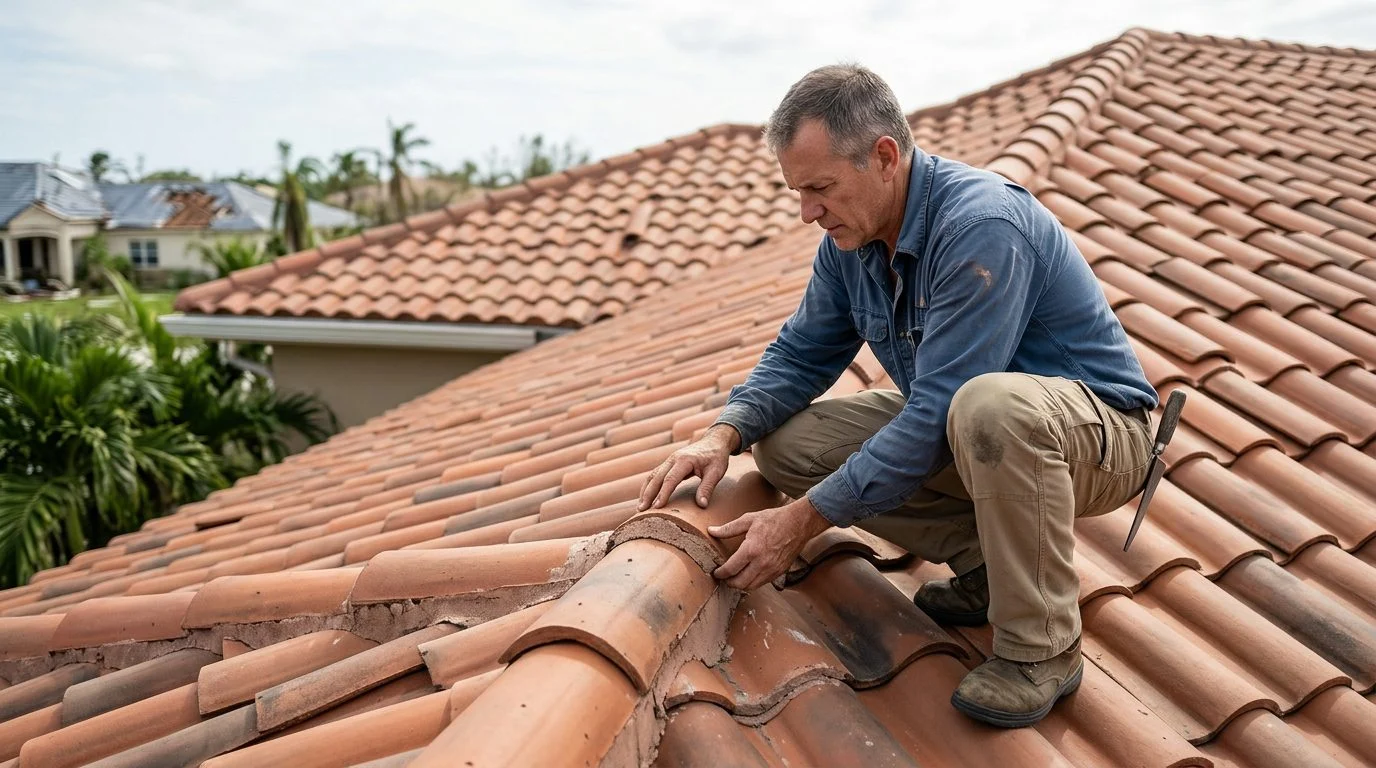
Roof tiles break in a hurricane because wind lifts them, debris strikes them, and weak fasteners let them move. Usually these forces work together, not one at a time. Tile roofs are heavy and often look solid from the ground, so cracks and loose tiles are easy to miss. Why do roof tiles break in a hurricane? This guide explains how the damage starts, where it shows up first on South Florida homes, and what to check after a storm.
What Happens to a Tile Roof When Hurricane Winds Hit
Hurricane winds push and pull on a tile roof with strong, uneven force. Wind moving over the roof presses down on the top surface, while suction pulls up from underneath. That pull is the first step toward tile damage.
Tile roofs are heavy. Each tile depends on a fastener, such as a nail, clip, or adhesive, to stay in place. When wind pushes on a tile, the force moves into those connection points. If a connection is weak, the tile shifts, lifts, or slides.
Concrete tile is a common roofing choice in South Florida. Miami-Dade County’s records list concrete as a recognized roof tile type. One Miami-Dade product approval for a concrete tile system states it is tested under TAS 112 and approved for specified High-Velocity Hurricane Zone applications. Even so, a tile is only as secure as its attachment, and installation and age matter.
Storm damage is usually a chain. Wind lifts a tile, the fastener fails, debris hits, and water follows. Looking at each step helps explain what happened to your roof.
If your tile roof lost pieces or shows water stains after a storm, our team can look at the damage with you and talk through your options. Talk it through with our team — the first consultation is free, confidential, and carries no obligation.
The Main Reasons Roof Tiles Come Loose or Break
Roof tiles come loose or break for four main reasons: failed fasteners, uplift, cracking under load, and blown-off sections. Each one starts in a different way, and they often overlap. This is the core answer to why do roof tiles break in a hurricane.
Fastening failure. Tiles rely on nails, clips, or adhesive. Those connections weaken with age or fail when they were not installed correctly. A weak fastener lets a tile slide or lift.
Florida law also ties fasteners to roof replacement. Under Fla. Stat. § 553.844, for site-built, single-family residential structures, a roof replacement must incorporate the techniques in subparagraphs (2)(b)2. and 4. The Fla. Stat. § 553.844 statute also lists prescriptive techniques for improvement of roof-to-wall connections as one of its retrofit techniques for existing buildings.
Uplift. When wind gets under a tile, it can break the tile or pull it off the roof. Neighboring tiles can go with it.
Cracking under load. Wind pressure and movement stress every tile. Tiles already weakened by age, an earlier impact, or poor installation are more likely to crack.
Blown-off sections. When fastening fails across one area, a whole group of tiles can lift away. That leaves the roof deck open to rain.
Why Edges, Ridges, and Corners Usually Fail First
Tiles at roof edges, corners, eaves, ridges, and hips usually fail first. Wind pressure is typically highest in these zones, so those tiles take the most stress.
Hip and ridge tiles, and tiles along the eaves and rakes, often show movement, cracks, or displacement first. Check these areas before you focus on the middle of a large roof.
When edge tiles fail, they can open a path for wind. Wind can then reach tiles and underlayment farther inward. A small loss at the edge can grow into a larger problem across the roof.
The National Weather Service’s Melbourne office documents that Hurricane Milton impacts brought hurricane-force winds and resulting roof and structural damage in east central Florida. Storms like this are the conditions where these failures show up.
How Flying Debris Breaks Tiles
Flying debris breaks tiles by striking them hard. Wind can drive branches, gravel, roof components, and other debris into the roof. The impact can chip a tile, crack it, or break it into pieces.
A single hit can start a crack that fails later. A tile may look fine right after the storm, then break in the next wind or rain. A roof can look lightly hurt and still need a closer look.
Debris damage often shows on the side of the roof that faces the wind. Check that side first. Look for chips and broken tiles in a pattern near where debris would have struck.
Tile pieces on the ground also tell a story. Fragments in gutters, the yard, or along the base of the house suggest tiles came off or broke. Note where you find them.
Water Damage That Follows Broken or Missing Tiles
Water gets into a tile roof when broken or missing tiles let wind-driven rain reach the layer beneath. Tiles are the first line of protection. Once they fail, rain can reach the underlayment and roof deck.
Water does not always drop straight down. It can run along the decking and show up in ceilings, insulation, or interior walls. The stain you see may be far from the actual opening in the roof.
A prompt inspection helps find the source before water spreads. Tiles can look intact from below while the underlayment beneath them is exposed. Finding the entry point is the hard part.
Signs of Tile Damage to Look for After a Storm
Look for missing, cracked, or shifted tiles, exposed underlayment, tile debris, and water stains inside. These signs point to damage that needs a closer look.
- Tiles that are missing, cracked, shifted, or out of line with their neighbors.
- Bare patches or exposed underlayment on the roof surface.
- Tile pieces in gutters, the yard, or along the base of the house.
- Water stains on ceilings or walls, or dampness near light fixtures and attic openings after rain.
Start with a view from the ground, using binoculars or a phone camera. Avoid climbing onto a damaged roof yourself.
Our team can evaluate how far roof damage reaches during a free first consultation, which is confidential and carries no obligation to continue. That is often more than what shows from the ground. Florida’s wind-mitigation inspection guide describes roof-related features that inspectors document.
Not sure what your next step is?
Talk it through with our team — the first consultation is free, confidential, and carries no obligation.
Talk With ASP Superhome About Your Tile Roof
If your tile roof has missing or cracked tiles, lifted edges, or water stains inside after a storm, ASP Superhome can look at the damage. We can explain what it means for repair or replacement.
Scope matters under Florida law. If an existing roof built, redone, or reworked under the 2007 Florida Building Code or a later edition has one-fourth or more of its area reworked, only the reworked section must comply with the code edition in effect at that time. This applies when the system was built, repaired, or replaced in compliance with the requirements of the 2007 Florida Building Code, or any subsequent editions.
Our first consultation is free, confidential, and comes with no obligation to continue.
Our tile roofing and roof repair pages cover these services in more detail. To talk about your roof’s damage, request a quote with our team.
FAQ
Why do roof tiles break in a hurricane?
Wind lifts tiles, debris strikes them, and weak fasteners let them move. Often several of these forces act at once.
Can wind lift tiles off a tile roof?
Yes. Wind can get under a tile, break it, or pull it off the roof.
Do tile roofs need to be re-fastened when they are replaced in Florida?
Does a wind mitigation inspection affect insurance premiums in Florida?
It can be used to seek premium discounts.
What Breaks Roof Tiles in High Wind
Wind uplift
Wind can get under a tile, lift it, and break it or pull it off the roof entirely.
Flying debris
Branches, gravel and other storm debris can strike tiles with enough force to crack them.
Weak fasteners
When tiles are not secured properly, they can shift and loosen as wind pressure builds.
Age and wear
Older tiles, underlayment and fasteners tend to lose strength over time, leaving more room for damage.
Don't Wait on Loose or Cracked Tiles
A single cracked or missing tile can expose the layers beneath it to rain. Small damage left alone can turn into leaks and larger repairs.
Steps to Protect a Tile Roof
Look at the tiles
Check for cracks, chips, slipped or missing tiles, especially along ridges, edges and corners.
Check the fastening
Ask whether the tiles, underlayment and fasteners are suited to the wind exposure of your home.
Plan repairs or replacement
Depending on the condition of the roof, repair or full replacement may be the better path forward.
Talk with Our Team About Your Tile Roof. Your First Consultation Is Free, Confidential, and Comes With No Obligation.
Related practice areas
- Tile Roofing in South Florida: Costs, Styles & Installation Guide


