


Roof Repair | South Florida
Roof Tiles Sliding Off After a Storm? Start With a Safe Look From the Ground
Here's how to spot storm damage on a tile roof, what to avoid doing, and when to bring in a professional for a closer inspection.
Start with a free first consultation
Free
First consultation
Confidential
Your information stays private
No obligation
Continue only if you choose to
By Jonathan Rodriguez · Published November 2, 2026
Roof tiles sliding off after a storm usually mean something under or around the tile has failed. The most common causes are loose or corroded fasteners, a damaged tile pan or underlayment, and wind uplift at the roof’s edges and ridges. Check safety first, document what you see, and look for signs of water inside. This guide walks through each cause so you know what to look for.
What Sliding or Missing Roof Tiles Usually Mean
Tiles that slide, lift, or disappear after wind usually point to a weak attachment or a weak layer beneath the tile. A random hit is rarely the whole story.
A tile roof depends on each tile staying in place. Fasteners or clips hold the tile down. A pan or underlayment sits underneath to shed water. If one of those parts fails, the roof is exposed at that spot.
The cause is often visible from the ground or from a careful inspection. You don’t need to climb the roof to start figuring out what happened. The sections below cover the most common causes, starting with the attachment hardware.
If tiles slid, cracked, or disappeared after your last storm, our team can assess the damage and walk you through a repair estimate. Talk it through with our team — the first consultation is free, confidential, and carries no obligation.

Failed or Corroded Fasteners and Clips
Loose, corroded, or badly installed fasteners are a common reason tiles slide. Tile is typically secured with nails, screws, or clips. Over time, these can loosen, rust, or back out.
A fastener that has backed out or snapped leaves the tile free. When wind pressure reaches that tile, it can slide or lift away. The neighboring tiles then take more stress.
Look for these signs:
- Tiles that sit out of line with the rows around them
- Tiles that shift when you press on them
- Tiles that rattle or clack in the wind
Florida law identifies strengthening or correcting roof-decking attachments and fasteners during reroofing among the techniques for improving existing buildings. For fasteners and connectors near the coast, the 2026 residential code adds requirements for areas within 3000 ft of a saltwater coastline, as shown in the Florida Building Commission analysis of 2026 residential changes. That is one reason to check hardware closely on a South Florida roof.
Broken Pans and Underlayment: What Happens Underneath
Yes, water can reach the layers under a tile that has moved or broken. The tile pan and underlayment are the layers meant to shed water beneath the visible tiles.
When a tile cracks or shifts out of position, wind-driven rain can get past it. The water can reach the underlayment and, over time, the roof deck below. That is why an exposed area needs prompt attention, even if it looks small from the ground.
Underlayment has its own code rules. The 2026 residential code requires underlayment to lap over hips and ridges a minimum of 6 inches, except where ventilation openings are provided, according to the Florida Building Commission analysis of 2026 residential changes.
Water often doesn’t show up inside right away. Check the attic or the ceiling below the affected area. Look for water stains, damp insulation, or drips after the next rain. Note where you find them, because that location helps match a leak to the tiles outside.
How Wind Uplift Moves Tiles Off the Roof
Uplift is the lifting force wind creates on a roof. Wind moves across and under roof edges, ridges, and corners. That force can overpower a tile’s attachment, especially where wind pressure is highest.
Tiles near edges, ridges, hips, and corners are often the first to slide. These zones take the strongest pull. A tile in the middle of a roof field may hold while the edge tiles lift away.
Repeated storms add up. A roof that held in one storm can show damage after a later one. Each event can loosen a fastener a little more. Uplift damage usually shows up as a pattern of tiles in the same zone, not scattered single tiles across the whole roof.
The 2026 Florida Building Code added a section requiring tile underlayment uplift resistance to meet the component and cladding loads of ASCE 7, according to the Florida Building Commission analysis of 2026 building changes. In plain words, the underlayment must be built to resist the wind forces on the roof’s surfaces and edges.
Are Broken or Missing Tiles a Problem?
Yes. Broken or missing tiles expose the underlayment, which can let water into the roof system. A single gap may look minor, but it isn’t harmless.
A missing tile can also stress its neighbors. Once one tile is gone, the tiles beside it may lose support and loosen. A small gap can become a row of problems after the next windstorm.
Broken tiles can also become loose debris. They can damage gutters, vehicles, windows, or people on the ground. Keep people and pets away from the area below the roof.
How much repair the roof needs comes down to three things. Those are how many tiles are affected, where they sit on the roof, and what is underneath them. A few tiles on a low slope differ from a row of tiles along a ridge with damaged underlayment.
What to Do First After a Storm
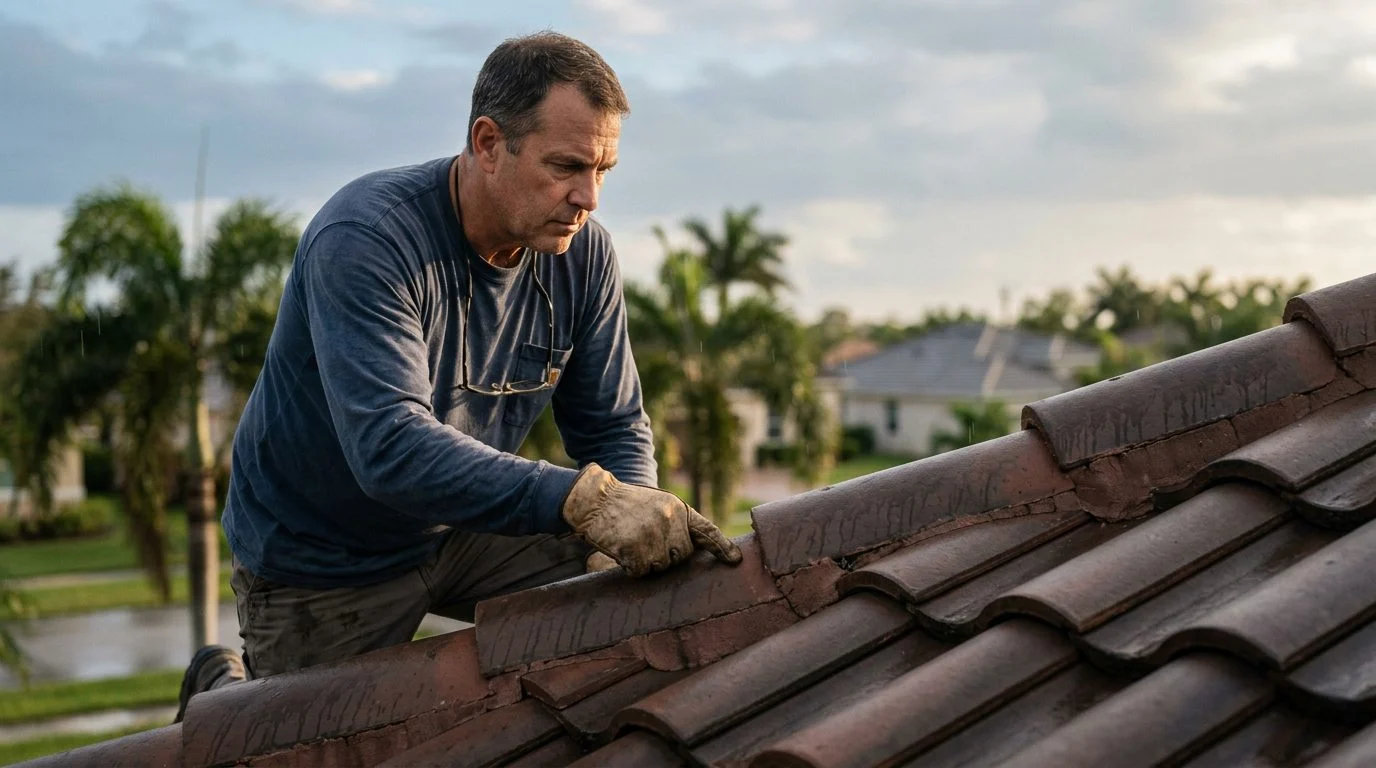
Start with safety. Don’t walk on a tile roof after a storm. Tile is slippery and fragile, and it can crack under a person’s weight.
Next, observe from the ground. Note which slopes, edges, or ridges show missing, shifted, or broken tiles. Look for debris piles along the walls or in the gutters.
Then document the damage. Take clear, dated photos and video from a safe distance. Capture any interior ceilings or walls that show staining. Dated images matter if you later talk with a roofer or an insurer.
Check the attic or top floor for water stains, damp insulation, or dripping after rain. Note where you find them compared with the exterior damage.
Cover exposed areas only if you can do it safely, without climbing onto the roof. A damaged roof is not a place for a do-it-yourself fix.
Keep a written record. Include the date of the storm, what you saw, and every step you took. A simple log keeps the timeline clear.
Not sure what your next step is?
Talk it through with our team — the first consultation is free, confidential, and carries no obligation.
Insurance, Documentation, and Deciding Between Repair and Replacement
Whether a tile roof can be repaired or needs replacement depends on several facts. Roof age, the number of affected tiles, and the condition of the fasteners and underlayment all count.
A repair estimate usually looks at how many tiles are affected, the condition of the fasteners and underlayment, and whether the damage is isolated or widespread.
Insurance deadlines matter. Under Fla. Stat. § 627.70132, a claim or reopened claim, but not a supplemental claim, under a property insurance policy is barred unless notice was given to the insurer under the policy within 1 year after the date of loss. A supplemental claim is barred unless notice was given within 18 months. For hurricanes, the date of loss is the date the hurricane made landfall; for tornadoes, windstorms, severe rain, or other weather-related events, it is the date the event is verified by the National Oceanic and Atmospheric Administration.
Coverage also depends on your policy. The Florida Office of Insurance Regulation explains that homeowners coverage depends on the policy form and on covered or excluded perils, and may include storm-related damage. Dated photos and a written record support any later talk about the damage.
Get a Tile Roof Repair Estimate After a Storm
If tiles slid, cracked, or disappeared after a storm, have the roof looked at before the next heavy rain. Early attention keeps a small gap from turning into a leak.
Can I walk on a tile roof after a storm?
No. Tile is slippery and fragile, so stay off the roof and watch from the ground.
Can you repair a few missing roof tiles?
A few tiles can sometimes be replaced. The right fix depends on where the tiles were and what sits underneath them.
Do roof tiles get wet underneath?
Yes. If a tile is displaced or broken, water can reach the layers below it.
How long do I have to file a storm claim in Florida?
Under Florida law, notice of a property insurance claim or reopened claim (but not a supplemental claim) is generally due within 1 year after the date of loss. A supplemental claim has an 18-month limit.
For broader information on tile roof types, repair, and replacement, see our tile roofing page. If your tiles have slid or cracked and you’re unsure what comes next, you don’t have to sort it out alone. Our team can schedule a free first consultation, which is confidential and carries no obligation to continue. We can look at the fasteners, tile pan, underlayment, and exposed areas with you and talk through a repair estimate. Request your consultation.
Stay off a damaged tile roof
Tile is slippery and fragile, and storm-loosened pieces can shift underfoot. Watch from the ground, take photos of what you can see, and leave any climbing to trained roofing crews.
What to check after the storm
Look from the ground
Scan the roofline and ridge for tiles that are missing, cracked, shifted, or sitting at an odd angle.
Check the yard and driveway
Fallen tiles, broken pieces, and debris near the walls often point to damage higher up.
Look inside the home
Water stains on ceilings, damp walls, or a musty smell can signal that water is getting past the tiles.
Document before you clean up
Take clear photos and videos of the roof and the interior before you move anything, so you have a record of what you saw.
Why homeowners contact ASP Superhome
Free first consultation
A confidential conversation about your roof, with no obligation to move forward.
Support from our team
Our team walks you through what we found and what your options look like, in plain language.
Built for South Florida homes
We focus on the roofs, storms, and building needs common across South Florida, from Miami to Naples.
Clear written estimates
You receive a detailed estimate for roof repair or roof replacement so you can compare the scope and decide with confidence.


