


Tile Roofs | South Florida
Hurricane Damage to Your Tile Roof? Repair May Be Enough
Learn how to tell when a few broken tiles can be fixed and when the roof needs replacing, and get a clear answer from an ASP Superhome estimate.
By Jonathan Rodriguez · Published October 25, 2026
Short Answer: Hurricane Damage Does Not Automatically Mean Replacement
Does hurricane damage mean you need a new tile roof? Not automatically. Some damaged tile roofs can be repaired, and some need full replacement. The answer depends on the facts: how many tiles are hurt, where they sit, what lies beneath them, and how old the roof was before the storm.
If you’re reading this with a damaged roof over your head, you’re probably worried about leaks, cost, and what comes next. That worry is normal. Homeowners from Miami to Naples ask this question after storms, and you don’t have to sort it out alone.
This guide covers how wind damages tile, the signs that point toward repair, the signs that point toward replacement, what a tarp can and can’t do, how inspections work, and how to weigh the cost.
If your tile roof took storm damage and you can't tell whether it can be repaired, our team will talk through what you're seeing with you. Talk it through with our team — the first consultation is free, confidential, and carries no obligation.

How Hurricane Winds Damage a Tile Roof
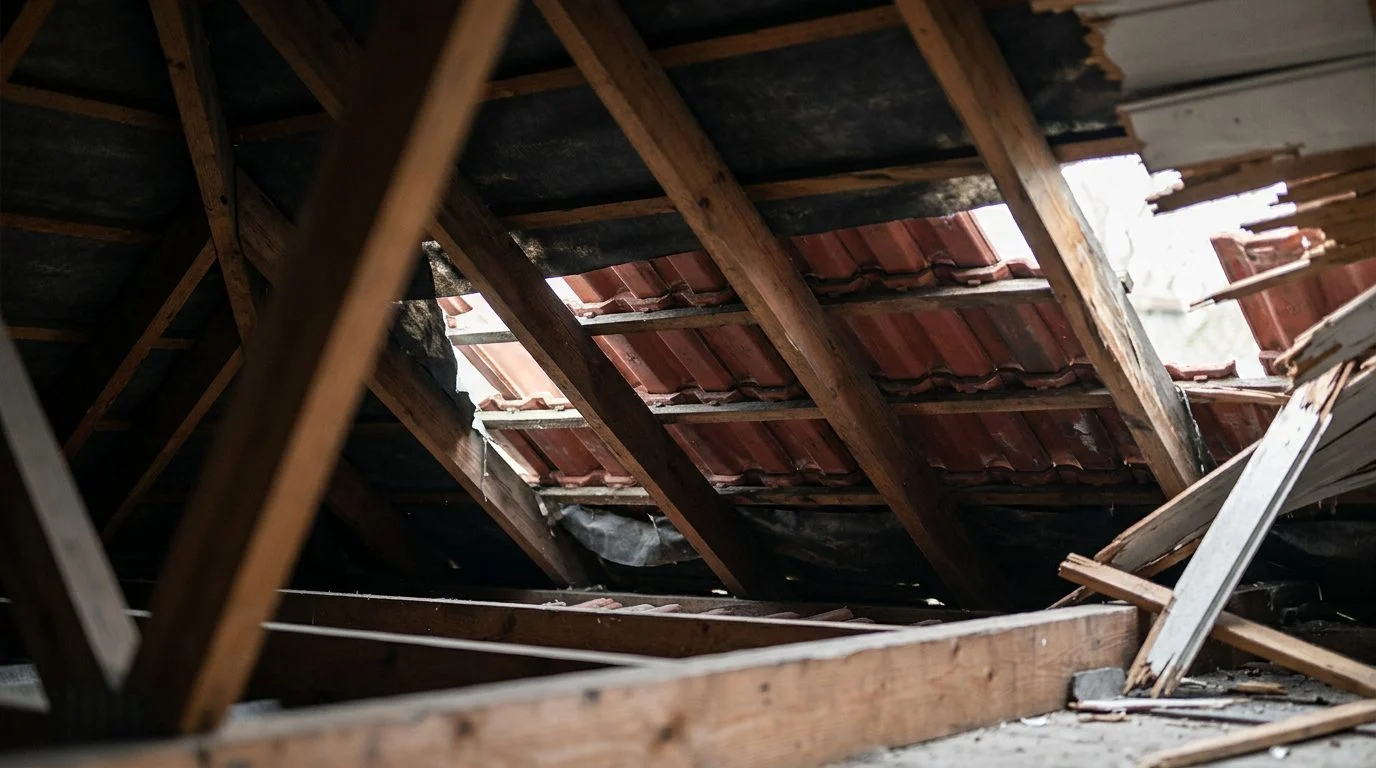
Wind damage on a tile roof usually starts at the edges. Wind gets under tiles and lifts them. This is called wind uplift. Edges, corners, ridges, and hips take the most force, so they often show damage first.
Once a tile slips or cracks, the layer beneath it is exposed. That layer is the underlayment, a water-resistant sheet that sits under the tile. Underlayment protects the roof deck, the solid base the tiles rest on. If the underlayment tears, rain can reach the deck and the rooms below.
Flying debris also chips and breaks tiles, most often on the side facing the wind. The National Roofing Contractors Association describes clay and concrete tile as durable and widely used in Florida. Durable doesn’t mean immune. A few broken tiles can still open a path for water.
Hidden damage is the hardest part. A roof can look fine from the ground and still leak days or weeks later. That’s why a close inspection matters more than a quick look from the yard.
Signs a Tile Roof Can Be Repaired
A repair often makes sense when the damage is small and contained. Look for these signs:
- A limited area of displaced or broken tiles that can be replaced with matching tiles.
- Underlayment and roof deck that still feel firm, with no widespread water getting in.
- Damage confined to one slope or one section of the roof.
- Clear records that show exactly where the damage sits.
Florida law matters here too. Under Fla. Stat. § 553.79, unless otherwise provided by law, it is unlawful to repair a building in Florida without first getting a permit from the appropriate enforcing agency. A small tile repair may still need a permit before work starts.
Our team offers roof repair, including targeted tile fixes, when the damage is limited and contained.
Signs That Point Toward Roof Replacement
Replacement usually makes more sense when damage is wide or the base of the roof is compromised. Watch for these signs:
- Tile loss across several slopes, leaving large areas of exposed underlayment.
- Soft, rotted, or water-damaged decking found during inspection.
- Repeated leaks in several rooms, or ceiling stains in more than one area.
- Tiles that are no longer made or no longer match, which makes a clean repair hard.
- An older roof with earlier damage that was never fully repaired.
Replacement also brings code requirements. Under Fla. Stat. § 553.844, a roof replacement on a site-built, single-family home must include specified windstorm mitigation techniques. Those include secondary water barriers, an extra layer that helps keep water out.
The NRCA also states that when another roof covering is replaced with tile, the building’s structural load capacity needs to be verified. Ask that this check happens before work begins.
Can a Tile Roof Withstand 100 mph Winds?
A tile roof’s wind performance depends on the tile profile, how the tiles are fastened, the underlayment, and how the roof was installed and kept up. Wind ratings describe tested conditions. They don’t show how one specific roof will perform in one specific storm.
Research on roof aging and wind has limits. Don’t assume a tile roof behaves like a shingle roof after a storm.
Metal is another option. That observation covers metal in that storm. It doesn’t predict how any roof will act in another one.
Our team offers both tile and metal roofing. Each has different uplift and maintenance points. Older roofs and roofs with earlier, unrepaired damage may be more vulnerable than their original rating suggests.
Can I Put a Tarp on My Roof to Stop Leaks?
A tarp can help limit water entry for a short time. It is a temporary measure, not a repair. Santa Rosa County’s claim guidance advises homeowners to promptly make only temporary repairs to prevent further roof damage.
Tarps have clear limits. Wind can tear them loose. Left on too long, they can trap moisture under the cover and make the damage worse. A tarp doesn’t fix broken tiles, damaged underlayment, or wet decking. Those still need a proper repair.
Safety comes first. Stay off a wet or unstable roof. Falls and electrical hazards are real risks after a storm, especially near power lines. Don’t climb onto a damaged, sloped, or wet surface to put a tarp up.
Photograph the damage before you cover it, and photograph the tarp after it’s in place. Then arrange a professional inspection as soon as conditions allow. The same county guidance notes that coverage for rain entering through a hurricane-created opening generally depends on the policy.
Not sure what your next step is?
Talk it through with our team — the first consultation is free, confidential, and carries no obligation.
How a Post-Storm Tile Roof Inspection Works
A post-storm inspection is a written check of the roof, from outside and inside. It shows what is damaged, where, and why it matters.
The inspection starts with a walkaround of the exterior. The inspector looks for displaced, cracked, or missing tiles and for marks left by debris. Next comes a close look at the ridge, hip, and edge areas, where uplift often starts.
The inspector also checks for exposed underlayment, flashing damage (the metal strips that seal joints and edges), and damage to gutters and fascia (the board along the roof edge).
Then the inspection moves indoors. Ceilings, attic space, and walls are checked for water stains and moisture. Attic staining can show a leak before it reaches the ceiling.
You receive written findings with photos. Those findings show what was found and why it matters. For a closer look at the process, read our tile roof inspection after hurricane South Florida guide.
How to Document Storm Damage Before Repairs Begin
Start documenting as soon as it’s safe, and before any repairs change the roof. Good records make every later step easier.
Take dated photos and video of the roof, the yard, and the inside of the home. Write down the storm date and each problem you notice. Save receipts for any temporary protection, such as tarps or boards. Keep inspection reports and repair estimates together in one file.
Timing matters for insurance claims. Under Fla. Stat. § 627.70132, a claim generally must be noticed to the insurer within 1 year after the date of loss. A supplemental claim for added damage from the same storm generally must be noticed within 18 months.
For hurricanes, the date of loss is the date the storm made landfall. For other weather events, it’s the date the National Oceanic and Atmospheric Administration verifies. Don’t wait for a deadline to start your file.
Is the Cost of Replacement Too Much? How to Weigh the Numbers
The cost of a new tile roof depends on roof size, tile type, pitch (steepness), the extent of damage, and whether decking needs replacing. Each roof is different, so a fair number comes from an inspection, not a rule of thumb.
Weigh your options using the same findings. Ask for a repair option and a replacement option, both based on one inspection. Consider remaining roof life, any history of repeat leaks, and whether matching tiles are available. Ask for line-item estimates so you can see what each option includes.
Insurance adds another layer.
Contract terms matter too. Under Fla. Stat. § 489.147, if the proposed roofing work is related to an insurance claim, the residential property owner should contact their insurance company to verify coverage for the work, including any claims, deductibles, and policy terms, before signing the contract.

Next Steps If You Are Unsure About Your Tile Roof
Start with a documented inspection. It shows the real condition beneath the tiles, not just the surface. Then connect the findings to your options: a targeted tile repair, leak work near chimneys or valleys, or full replacement.
Leaks near chimneys and valleys deserve their own close look, since those spots need careful flashing work. Our team can walk you through whichever path the inspection supports.
Quick Answers
Does hurricane damage always mean a new tile roof?
Not always. Repair can be enough when the damage is limited and the roof deck is sound. Under Fla. Stat. § 553.844(5), if an existing roofing system built or repaired to the 2007 or later Florida Building Code has 25 percent or more repaired, replaced, or recovered, only that repaired portion must meet the code in effect.
Can a tarp stop leaks on a tile roof?
A tarp can limit water entry for a short time. It is not a repair, so permanent work is still needed.
How long do I have to file a hurricane roof claim in Florida?
Under Fla. Stat. § 627.70132, a claim generally must be noticed within 1 year after the date of loss.
If your tile roof took storm damage and you can’t tell whether it can be repaired, contact ASP Superhome and talk through what you’re seeing. The first consultation is a free, confidential consultation with no obligation to continue.
How ASP Superhome Approaches Storm-Damaged Tile Roofs
Inspection first
We look at the tiles, underlayment, flashing, and roof deck before recommending repair or replacement.
Honest options
We explain what can be repaired, what should be replaced, and what each choice involves.
Prompt response
Storm damage can worsen with every rain. We aim to get to your home quickly after you reach out.
Confidential consultation
Your first consultation is free, confidential, and comes with no obligation to continue.
A Tarp Is a Temporary Fix
A tarp can slow water intrusion while you wait for help, but it can blow loose in high winds and can trap moisture under the tiles. Have a professional inspect the roof as soon as it is safe to do so.
Key Questions for Repair or Replacement
Roof deck condition
Soft, rotted, or water-stained decking often points toward a larger job than tile repair alone.
Extent of tile damage
A few cracked or displaced tiles are often repairable. Widespread breakage across many sections changes the picture.
Leaks and water intrusion
Water reaching the interior, attic, or ceiling can signal damage beneath the tiles that is not visible from the ground.
Age and past repairs
An older roof with multiple prior repairs may be a better candidate for replacement than for another patch.
Not Sure Whether Your Tile Roof Needs Repair or Replacement? Book a Free Estimate with ASP Superhome.
Related practice areas
- Tile Roofing in South Florida: Costs, Styles & Installation Guide
- Tile Roofing in Miami


