


Roof Replacement | South Florida
Understanding Your Wind Deductible Before Roof Replacement
Learn how a wind or hurricane deductible can affect the cost of replacing your roof, and what to review in your policy. Start with a free, confidential first consultation with ASP Superhome.
By Jonathan Rodriguez · Published October 27, 2026
A wind deductible is the share of storm damage you pay before your insurer pays the rest. For a wind deductible roof replacement Florida claim, the percentage on your policy decides how much that share is. This guide explains how the deductible works, what each side records, and how to prepare before the adjuster visits. It is written for homeowners in Miami, Fort Lauderdale, West Palm Beach, Boca Raton, Kendall, Naples, and Fort Myers.
How a Percentage Wind Deductible Works on a Roof Claim
A percentage wind deductible is a set share of your home’s insured value that you pay before coverage applies to wind damage. A flat deductible is a fixed dollar amount. Your policy decides which type applies, so read it closely.
Wind and hurricane deductibles are often separate from the all-perils deductible on the same policy. A roof damaged by wind may fall under a different deductible than a plumbing leak. Confirm which one applies before you plan around a number.
Roof replacement and roof repair follow the same logic. However, if a roof deductible is applied to the insured loss, the insurer may limit the claim payment as to the roof to the actual cash value of the loss to the roof until the insurer receives reasonable proof of payment by the policyholder of the roof deductible. For a broader overview, read our roof replacement guide.
If a storm damaged your roof and the wind deductible is unclear, our team can talk through whether repair or replacement makes sense for your home. Talk it through with our team — the first consultation is free, confidential, and carries no obligation.
Finding the Percentage and Dollar Amount on Your Policy
Your wind deductible percentage usually appears on the declarations page, the summary page of your policy. Look for a line that names windstorm or hurricane deductibles, often with a percent sign.
Many percentage deductibles are based on the dwelling coverage limit, the amount your policy lists to rebuild the home’s structure. That is why the dollar figure can be large.
Here is a hypothetical example for illustration only. A $350,000 dwelling limit with a 2% wind deductible works out to $7,000 (2% of $350,000). Your numbers will differ.
Confirm the terms with your own insurer and your written policy before you assume an amount. Policy forms vary from one company to another.
When a Roof Replacement Claim Reaches the Deductible
A roof claim pays only the covered loss above your deductible. A small storm loss may pay nothing after the deductible is applied. Whether a roof replacement claim clears the deductible depends on the facts: how much damage there is, the roof’s size and covering, and your policy terms.
Damage can be partial or full. Partial damage often affects a section of shingles, tiles, or metal panels. Full replacement usually follows when damage spreads across the roof. The adjuster’s findings decide which path the claim takes.
Florida law also limits roof payments in one specific case. When a roof deductible applies, the insurer may limit the roof payment to actual cash value until it gets reasonable proof you paid that deductible, under Fla. Stat. § 627.7011. Proof can be a canceled check, a money order receipt, a credit card statement, or a copy of an executed installment plan contract or other financing arrangement that requires full payment of the deductible over time. Keep these records.
You can ask your insurer to explain in writing how it applied the deductible. A written breakdown makes the math easy to check.
What the Insurance Adjuster Documents
The insurance adjuster records what the storm did to your roof and what the insurer will pay to address it.
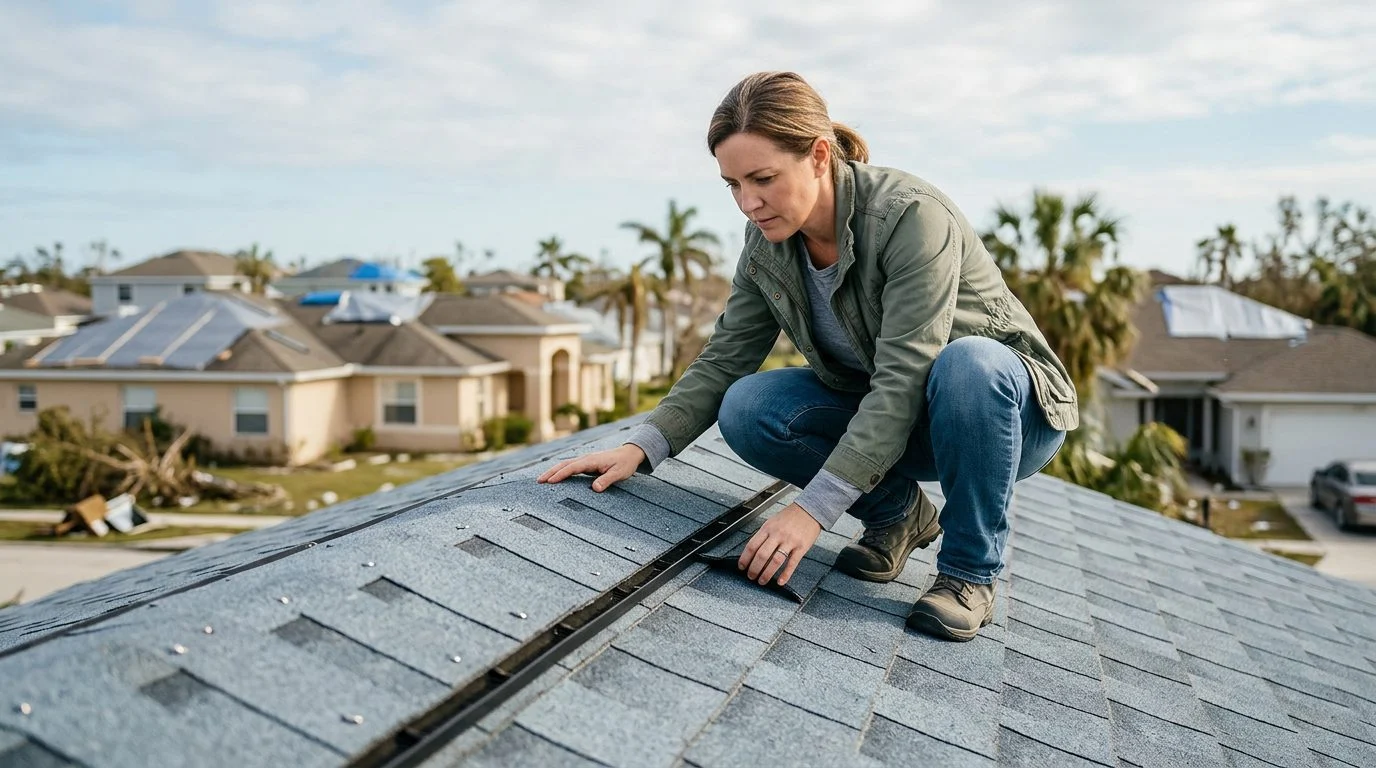
The adjuster usually checks the roof slope, the covering type (shingle, tile, or metal), lifted or missing shingles or tiles, damaged flashing, and vents. Notes on gutters and interior ceilings also matter, because water entry shows the path of damage.
The adjuster then writes an estimate with line items. A repair estimate covers specific areas. A replacement estimate covers the whole roof. A roofing contractor’s estimate can differ because it uses different measurements, scope, and pricing assumptions.
The claim file also needs photos, roof measurements, and the date of loss. For claims resulting from hurricanes, tornadoes, windstorms, severe rain, or other weather-related events, the date of loss is the date the hurricane made landfall or the event is verified by the National Oceanic and Atmospheric Administration, under Fla. Stat. § 627.70132. That date starts your notice clock.
What the Roofing Contractor Documents
A roofing contractor documents the damage and the work it would take to fix it. Those records can support your claim when it is reviewed.
Useful contractor records include dated photos of each damaged area, roof measurements, and a written scope of work. Close-up shots show cracks and lifted pieces. Wider shots show how far the damage reaches.
Notes on roof age, prior repairs, and the covering material matter too. A tile roof and a metal roof can show damage in different ways. A prior repair can change how a reviewer reads new damage.
If your roof repair or replacement relates to an insurance claim, contact your insurance company to verify coverage, claims, and deductibles before you sign a contract. Read that language before you sign.
Roof Repair or Replacement After a South Florida Storm
Repair or replacement depends on how much of the roof is damaged, how old it is, and its condition before the storm.
Roofing material matters after a storm. Roof cover performance in Southwest Florida after Hurricane Ian is covered in the IBHS Hurricane Ian roof study.
Wind mitigation matters too. Section 627.711, Florida Statutes provides that, using a form prescribed by the Office of Insurance Regulation, a company must clearly tell the applicant or the holder of a home insurance policy, when the policy is written and again whenever it is continued, about the availability and range of each discount, credit, other rate differential, or deductible reduction for properties where fixtures or construction methods that can lessen wind damage can be or have been installed or used. The Florida Office of Insurance Regulation says homeowners can submit an official mitigation inspection form to an insurance agent to seek those discounts. Discount amounts vary by insurer, so ask your agent what applies to your policy.
Permits also apply. Plan for that timing. For Miami roof work, see our Miami roof replacement page.
Not sure what your next step is?
Talk it through with our team — the first consultation is free, confidential, and carries no obligation.
How to Prepare Before the Adjuster Visit
Before the adjuster arrives, document the damage and keep your paperwork in order.
Take dated photos and video of the roof, gutters, and ceilings, from outside and inside. Do this before any cleanup. Wide shots show the whole area, and close shots show specific cracks, lifted pieces, or water spots.
Keep your declarations page, your claim number, and all written messages in one folder. Write a short timeline of when you first noticed damage and what the weather was on those dates.
Timing matters. Under Fla. Stat. § 627.70132, a claim is barred unless notice was given to the insurer under the policy terms within 1 year after the date of loss. A supplemental claim is barred unless notice was given within 18 months. Report early.
Avoid permanent repairs until the adjuster has documented the damage. If you must make emergency repairs to stop more water, keep the receipts and photos of that work.
Talk With Our Team About Your Storm-Damaged Roof
A wind deductible for roof replacement in Florida can feel hard to sort out while you’re dealing with water in the house. Common questions include these.
Does a wind deductible apply to a roof replacement?
A wind or hurricane deductible can apply to a roof claim. Your policy sets the percentage and the terms.
Is the deductible based on the dwelling limit?
Often it is. Check your declarations page to confirm how your policy calculates it.
How long do I have to report a roof claim?
Under the statute, notice generally must be given within 1 year after the date of loss, under the policy terms.
If a storm damaged your roof and you’re unsure how the wind deductible affects a repair-or-replace choice, our team at ASP Superhome works on roof replacement, roof repair, metal roofing, and tile roofing. Our first consultation is free, confidential, and carries no obligation to continue. Book your free first consultation to talk through your roof.
How ASP Superhome Can Help
Review Your Roof Project
We walk through the scope of your roof replacement so you can see the work, the materials, and the estimate in one place.
Clear Answers, Plain Language
Our team explains how a wind deductible may apply to your roof project without the jargon.
Options for Your Home
From metal and tile roofing to impact windows and doors, we help you weigh options that fit your home and budget.
Confidential, No-Obligation Start
Your first consultation is free, confidential, and carries no obligation to continue.
Check Your Policy First
Your policy sets the terms of any wind or hurricane deductible, including how it is calculated. Have your declarations page handy when you schedule your consultation so we can discuss your roof project with the details in front of us.
Key Terms to Know
Wind vs. Hurricane Deductible
Many South Florida policies list a separate wind or hurricane deductible alongside the standard deductible. Knowing which one applies matters for roof work.
Dwelling Limit
Your declarations page shows the dwelling coverage limit, which is often connected to how the wind deductible is figured.
Roof Replacement Scope
The scope of the job, from tear-off to new materials, shapes the estimate you review with your insurer and with us.
Documenting Your Roof
Clear photos, measurements, and written estimates help keep your roof project organized from the first visit onward.
Have Questions About Your Roof and Deductible? Let's Talk.
Related practice areas
- How Do I Know If I Need a New Roof or Just Repairs?
- Kitchen Island Design Ideas for South Florida Homes


