


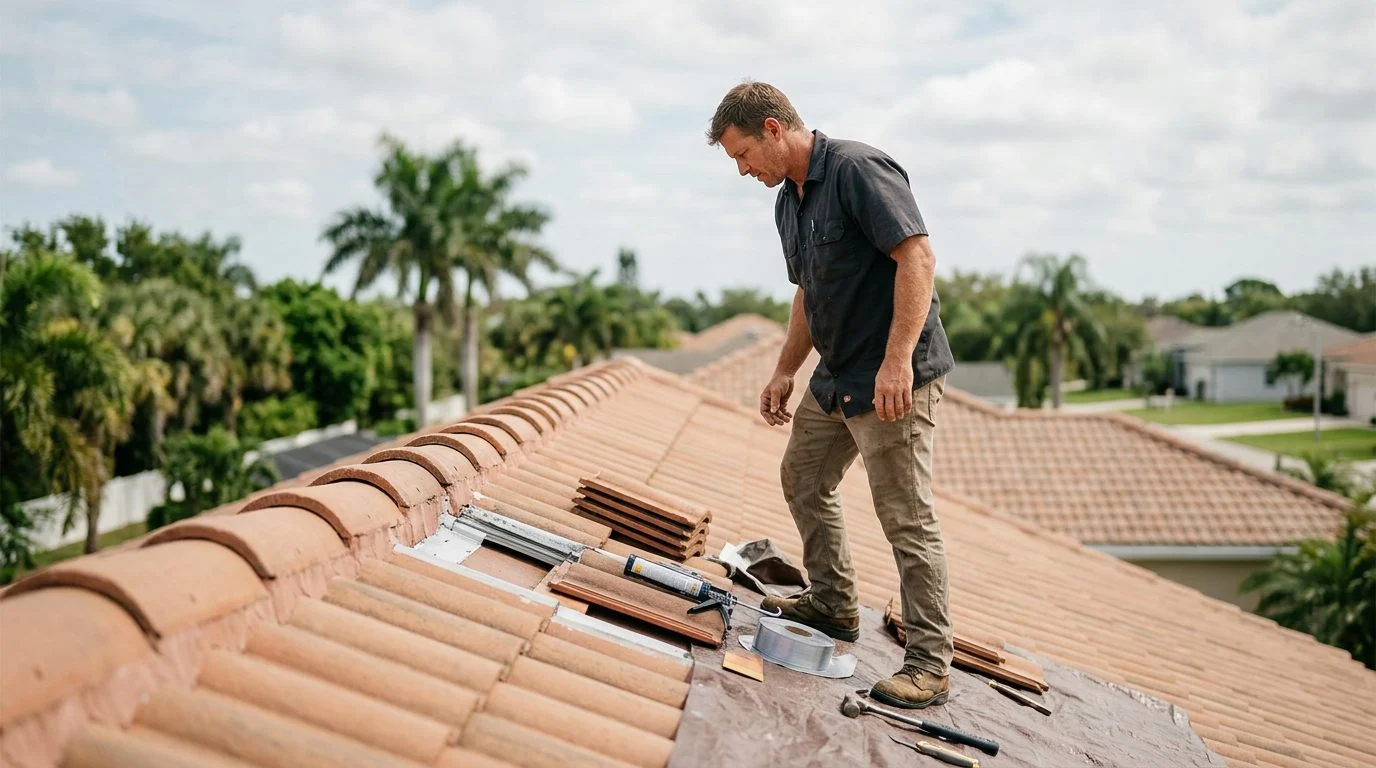
Tile Roof Repair | South Florida
Storm Damaged Your Tile Roof? Start Here, Step by Step
A clear first-week guide to staying safe, protecting your home, and getting your tile roof repaired after a South Florida storm.
By Jonathan Rodriguez · Published November 7, 2026
After a storm, storm damage tile roof repair follows a clear order: stay safe, record the damage, protect open areas, then plan the permanent repair. This guide walks South Florida homeowners through each step, from Miami and Fort Lauderdale to Naples and Fort Myers.
Why the First Week Matters for a Storm-Damaged Tile Roof
The first week is when small openings are easiest to catch, before water reaches the inside of the home. A storm can crack or slip tiles and lift flashing without leaving signs you can spot from the ground. Wind can also loosen the fasteners that hold tiles in place. The next rain then finds the gap. Many leaks start small and show up days later as a stain on a ceiling.
This guide follows a set order. You’ll learn how to stay safe, record the damage, tell temporary protection from permanent repair, and what the repair process looks like. For the wider picture, see our roof repair guide for South Florida.
If storm damage has left your tile roof leaking or missing tiles, contact our team now so the inspection and temporary protection can be scheduled while the damage is fresh. Talk it through with our team — the first consultation is free, confidential, and carries no obligation.

Stay Off the Roof Until It Is Safe
Don’t climb on a tile roof after a storm, even if the damage looks minor. Wet or cracked tile is brittle, and pieces loosened by wind can slide without warning. A fall from a roof causes serious injuries, and climbing up to look is a common mistake in the first days.
Check for hazards from the ground first. Look for fallen limbs resting on the roof, power lines near the roofline, and debris in the yard or driveway. Stay well clear of any line that may be live. If a limb or wire touches the house, keep people away from that wall until the hazard is gone.
Keep children and pets away from the area below the roof edge while loose tiles are still in place. A tile that falls from the eave can hit someone standing right beneath it. Block off that spot with a rope, a chair, or a cone. A trained crew can walk the roof safely and check the areas you can’t see from the ground.
Document the Damage Before Anything Is Moved
Photograph the damage before you move debris, add a tarp, or start cleanup. Take photos of the roof from several angles, from the ground and from a window if that is safe. Turn on the date and time stamp for each photo. Then photograph the inside of the home, including every ceiling stain and any soft spot in drywall.
Write down where water entered and which rooms were affected. Note any debris that landed on the roof or in the gutters. Keep receipts for emergency materials and temporary work, such as tarps or plywood.
Your records matter for your insurance claim. Florida law sets a deadline for notice. A claim or reopened claim, but not a supplemental claim, under a property insurance policy is barred unless notice reaches the insurer under the policy terms within 1 year after the date of loss. A supplemental claim for added damage from the same peril has an 18-month window (Fla. Stat. § 627.70132). For claims from hurricanes, tornadoes, windstorms, severe rain, or other weather-related events, the date of loss is the date the hurricane made landfall, or the date the event is verified by the National Oceanic and Atmospheric Administration. Write that date in your notes now.
Common Tile Roof Damage From Storms
Cracked or slipped tile and damaged flashing are common storm damage points on tile roofs. Look for these four problem areas:
- Cracked, chipped, or slipped tiles, especially at the ridge, hip, or eave.
- Lifted or damaged flashing around chimneys, vents, skylights, and valleys. Flashing is the metal or sealed strip that keeps water out at joints, and it is a frequent source of leaks.
- Loose connections and fasteners that let tiles or flashing move in wind.
- Impact damage from limbs or debris that cracks tiles or dents what sits below them.
A tile roof can leak even when no tile looks broken. Water can slip under a shifted tile or enter through a damaged flashing joint. Underlayment, the water-resistant layer under the tile, can also be torn or exposed by wind. The Tile Roofing Industry Alliance guidance covers inspecting underlayment after a storm.
Florida code also shapes repairs. The 2026 Florida Building Code added a drip edge section for tile roofs. It requires drip edge on roof slopes of 2:12 and greater, applied under the Florida high wind tile installation manual (Florida Building Commission analysis).
Tarp, Patch, or a Larger Repair: Protecting the Home
Temporary protection keeps water out while a permanent plan is made. It is not the final repair. A tarp or a targeted patch covers open areas for now. It stops rain from reaching the attic or the ceiling below. It does not replace broken tiles or repaired flashing.
Ask the crew to mark which parts are temporary and which are permanent. That way you know what still needs to happen, and when.
Whether a tarp, a patch, or a larger repair fits depends on the facts of your roof. The extent of damage, the number of open areas, and the condition of the underlayment all count. The Tile Roofing Industry Alliance guidance covers choosing between repair and replacement. Our team can explain how the repair scope applies to your roof.
Insurance payments follow a set pattern too. For a dwelling insured at replacement cost, the insurer must first pay at least the actual cash value of the loss, less your deductible. It pays the rest as work is performed and expenses are incurred (Fla. Stat. § 627.7011). If a roof deductible applies, the insurer may limit the roof payment to actual cash value until it gets reasonable proof you paid that deductible.
From the First Call to the Final Photos
The storm damage tile roof repair process runs in four steps, and the first is a conversation about what you saw. Each step builds on the one before it.
Step one: you describe the storm, when it hit, and where water appeared. Step two: our team inspects the tile, flashing, and connections, then explains the findings in plain terms. Step three: temporary protection goes in where needed, and the permanent repair is scheduled with you. Step four: you receive final photos of the completed work, so you have a record.
Our team handles tile roof repair alongside related work, such as roof replacement, when repair is not enough for the damage.
Florida law shapes the paperwork, too. If the proposed roofing work is related to an insurance claim, review coverage, claims, deductibles, and policy terms with your insurer before signing. Permits have limits too. A building permit issued by a local government for a single-family home expires 1 year after issuance, or on the effective date of the next code edition if that is later, though a local government may extend it beyond the expiration date (Fla. Stat. § 553.79).
Not sure what your next step is?
Talk it through with our team — the first consultation is free, confidential, and carries no obligation.
Getting Ahead of the Next Storm
Check the roof after every significant storm, focusing on tiles, flashing, and gutters. Walk the yard from the ground first. Look for tiles on the lawn, shifted tiles along the edges, and gutter debris. Then check the ceilings inside for new stains.
Trim overhanging limbs away from the roof. Branches that rub or strike tiles in wind are a repeat cause of cracks. Remove dead limbs before storm season starts.
Keep the roof’s repair history, photos, and invoices in one folder. A known baseline makes the next inspection faster and clearer. It also gives you dates and records if you need to report a new storm loss. Impact windows and impact doors protect openings from wind-borne debris, which is another way to reduce storm losses on the home.
Ready to Get Your Tile Roof Looked At?
If your tile roof has storm damage, leaks, or missing tiles, book your first consultation now. Every rain that reaches an open joint adds water to the roof deck and the rooms below. Contact our team to schedule your free first consultation. It is confidential, and there is no obligation to continue.
Frequently Asked Questions
What should I do first after a storm damages my tile roof?
Stay off the roof, check for hazards from the ground, and photograph the damage before moving anything.
Is a tarp a permanent fix?
No. A tarp is temporary protection that keeps water out until the permanent repair is done.
Why Homeowners Start With ASP Superhome
Free first consultation
Our first consultation is free, confidential, and comes with no obligation to continue.
Roof repair and roof replacement
We handle tile roof repair after storm damage, along with broader roof replacement when a repair is not enough.
Serving South Florida
We work with homeowners in Miami, Fort Lauderdale, West Palm Beach, Kendall, Naples, Fort Myers, and Boca Raton.
A team that keeps you informed
Our team walks you through each step so you know what is being done to your home and why.
Safety First: Do Not Climb onto a Damaged Roof
Broken or loose tiles can slip, and storm-weakened roofs can give way. Stay off the roof, keep people and pets away from the area below, and look for hazards such as sagging ceilings or exposed wiring from the ground or from inside the home.
Your First Week After a Storm
Day 1: Secure the area
Keep everyone clear of the roof and any damaged areas. If water is coming into the home, move belongings and place buckets under active leaks.
Day 2: Document the damage
Photograph the roof, tiles, gutters, and interior ceilings before moving anything. Clear, dated photos make the damage easier to explain to anyone reviewing it.
Day 3: Add temporary protection
A tarp is temporary protection that keeps water out until the permanent repair is done. It is not a substitute for a proper repair.
Days 4 to 7: Get a repair plan
Have a professional inspect the roof, identify broken or displaced tiles, underlayment problems, and flashing damage, and outline a repair or replacement plan.


