


Metal Roofing | South Florida
Are Metal Roofs Safe in Hurricanes?
The material matters, but the full roofing system decides how well your home holds up in high winds. Here is what South Florida homeowners should know.
By Jonathan Rodriguez · Published October 25, 2026
Are Metal Roofs Safe in Hurricanes? The Short Answer
Metal roofs can perform well in hurricanes, but “safe” depends on the specific roof system, how it is attached, and how it was installed. The material alone does not decide the outcome. Are metal roofs safe in hurricanes? For many South Florida homes, a properly engineered and installed metal roof is a strong option.
Maybe you’re researching this after a storm. Maybe you manage a rental, or you’re helping a parent whose roof is getting old. This guide covers the factors that matter most: wind ratings, fastening method, debris and impact, water control, and maintenance.
If a storm has left you wondering whether your roof can handle the next one, our team can talk it through with you. Talk it through with our team — the first consultation is free, confidential, and carries no obligation.
How Metal Roof Wind Ratings Work
A wind rating applies to a tested assembly, not to “metal roofing” in general. The assembly includes the panel profile, the fastener pattern, the roof deck, and the underlayment. Change one part and the rating may no longer apply.
Some listings quote a single number, such as 140 mph. Treat that number as a starting point only. The rating that matters is the one listed for the exact approved system on your roof.
Florida law sets the framework. The Florida Building Code governs the design, construction, and repair of buildings. Roofing is also one of the product categories that must receive statewide approval under Fla. Stat. § 553.842. That statute also says a product may not be marketed as hurricane or windstorm protection unless it is approved.
Ask for the approval paperwork before work starts. Fla. Admin. Code R. 61G20-3.005 requires evaluation and test reports to state the tested standard and the limitations and conditions of use. Those details tell you what the roof was actually tested to do.
Standing Seam vs. Exposed Fastener: Why Attachment Matters
A standing seam system raises the panel edges above the roof surface. Panels lock together with concealed clips, so fewer screws pierce the metal. Fewer exposed fasteners means fewer places where water or wind can work in.
An exposed fastener system uses screws that go through the panel and into the deck. Its performance depends on fastener spacing, the condition of the screws and washers, and how well the seals hold. Fasteners can back out over time, so inspection matters more with this type.
Salt air matters in South Florida. Many coastal roofs use Galvalume, a metal coating chosen for corrosion resistance. Coating choice affects how long the metal holds up near the coast. Ask which coating the product uses and why.
The main drawbacks of exposed fastener roofs are about upkeep. They need more attention over the years. The metal itself is not the problem.
Debris, Impact, and Water: What Metal Handles and Where It Has Limits
Metal does not rot, and it does not feed mold the way wood does. It also resists fire well. Those traits matter in Florida’s humid, storm-prone climate.
Metal has limits. Large flying debris can dent or puncture thin panels. Panel gauge (thickness) and profile affect how well a panel resists that damage. A metal roof does not make a home immune to hurricane damage.
Water control depends on details. Seams, flashing, and penetrations like vents, chimneys, and skylights must be sealed and detailed correctly. Leaks usually start at these points, not in the middle of a flat panel.
Florida law also recognizes that roofs need more than one line of defense. Fla. Stat. § 553.844 says, for site-built, single-family homes built before the Florida Building Code took effect, the criteria for secondary water barriers on roofs may not be limited to one method or material.
Real-World Hurricane Performance: What Determines the Outcome
Observed damage gives useful evidence. The Insurance Institute for Business & Home Safety reported on roof cover performance in Southwest Florida after Hurricane Ian.
Installation quality is one of the strongest factors. Fastener pattern, edge metal, underlayment, and how the panels attach to the deck all matter. A metal panel is only as secure as the deck and structure beneath it.
Metal roofs that are properly selected and installed should meet applicable wind-uplift, installation, and attachment standards. That is the view of the Building America Solution Center. Compare the rated systems side by side, not the materials alone.
Partial work has its own rule. If an existing roofing system or roof section was built, repaired, or replaced in compliance with the 2007 Florida Building Code or any later edition, and 25 percent or more of that roofing system or roof section is repaired, replaced, or recovered, only the repaired, replaced, or recovered portion is required to be built to the Florida Building Code in effect.
How any roof performs in a specific storm depends on wind speed, debris, and how the system was installed and maintained.
Maintenance, Inspection, and Walking on a Metal Roof
Inspect fasteners, seams, sealants, and flashing regularly. Check them again after any strong storm. Small problems are easier to fix before wind and water find them.
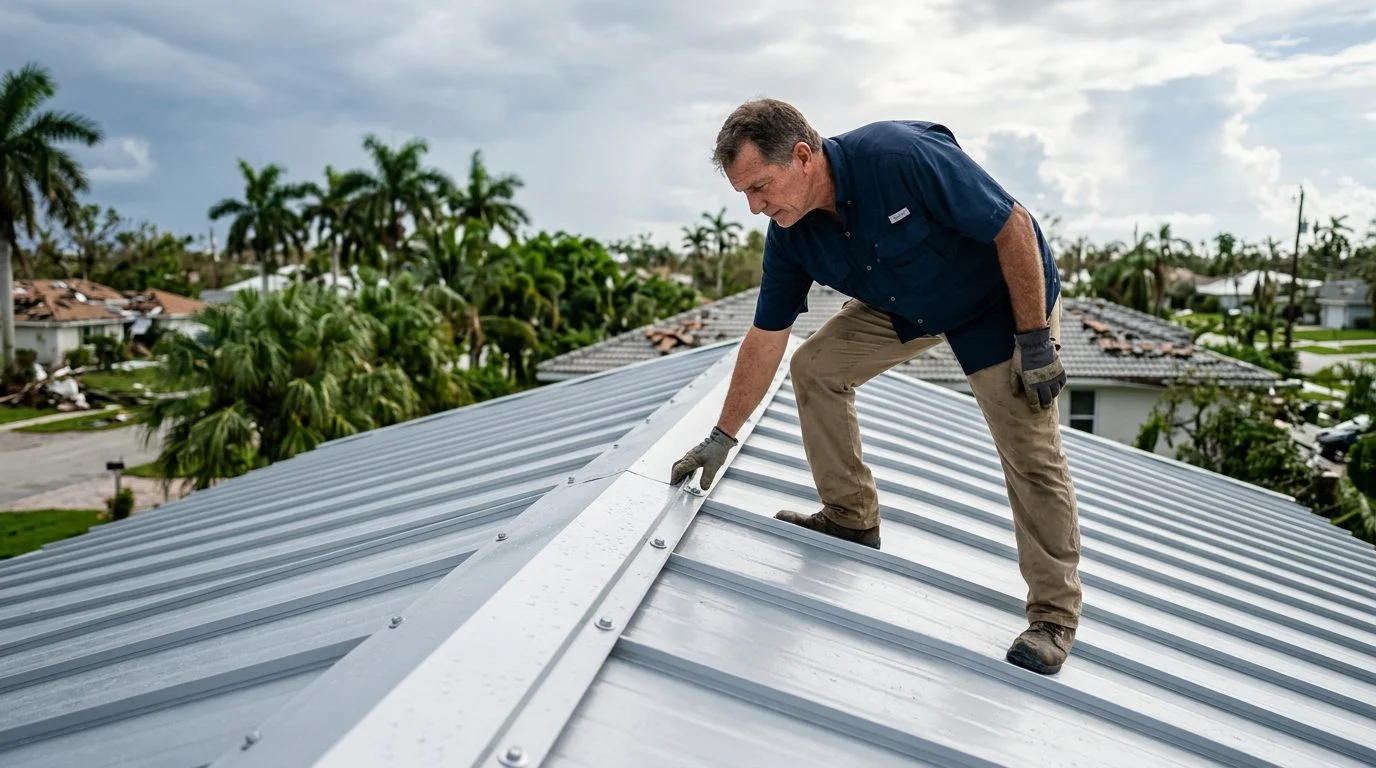
Walking on metal is risky. Panels can dent or scratch under foot traffic, and dropped tools can damage them. Never walk on wet panels. Roofing work carries serious fall hazards, as the Occupational Safety and Health Administration explains. Most homeowners should not climb up to inspect a roof.
Keep a dated photo record of the roof before and after storm season. Keep installation records and product approval paperwork with your home documents. These records help you track changes over time.
Light-colored or reflective metal can also help. The ENERGY STAR cool roofs program notes that lighter, more reflective metal colors generally stay cooler in hot, sunny climates like Florida.
Not sure what your next step is?
Talk it through with our team — the first consultation is free, confidential, and carries no obligation.
Talk Through Your Roof With Our Team
Metal can be a sound choice in hurricane-prone South Florida, but the specific system decides the result. If a storm damaged your roof, or you manage a property that needs a new one, you may not be ready to choose a contractor yet. That’s normal.
ASP Superhome offers a free first consultation. It is confidential and comes with no obligation to continue. We can look at your roof, deck, and wind requirements with you. Our team works on metal roofing, tile roofing, and roof replacement, and we can talk through what fits your home.
Request your free initial consultation
Frequently asked questions
Are metal roofs safe in hurricanes?
Metal roofs can perform well when the specific system is approved, properly installed, and maintained. The material alone does not decide the outcome.
What wind rating should a metal roof have in Florida?
Look for the rating listed for the exact tested system on your roof. A single headline number is not enough.
Is standing seam better than exposed fastener for hurricanes?
Standing seam uses fewer exposed fasteners, which lowers one common point of failure. Installation quality still determines how either system performs.
Does Florida require approval for hurricane roofing products?
Yes. Roofing is one of the product categories that the statewide product evaluation and approval system must cover, and a product may not be advertised, sold, offered, provided, distributed, or marketed as hurricane, windstorm, or impact protection from wind-borne debris unless it is approved under that system.
What Makes a Metal Roof Hold Up in Wind
A tested, approved system
Look for the wind rating of the exact roofing system installed on your home, including panels, fasteners, and underlayment, rather than a single headline number.
Proper installation
Fastener spacing, edge securement, and flashing details have a major effect on whether a metal roof stays attached in strong wind.
Consistent maintenance
Loose fasteners, damaged seams, and worn sealants should be checked regularly, especially after storm season.
The whole roof, not just the panels
Decking, roof-to-wall connections, and the condition of the existing structure all influence overall performance.
Important: Material Alone Is Not Enough
A metal roof is not automatically hurricane-safe. Performance depends on the specific approved system, correct installation, and upkeep over time. Before choosing a roof, confirm these details in writing.
Questions to Ask About Your Roof
Which exact system is proposed?
Ask for the product and assembly details, not only the brand name or panel style.
What wind rating applies?
Request documentation tied to that exact system, and confirm it matches your home's location and exposure.
How will it be attached?
Ask how fasteners, edges, and penetrations will be installed and inspected.
What maintenance will keep it performing?
Understand the inspection schedule and what to check after major storms.


