


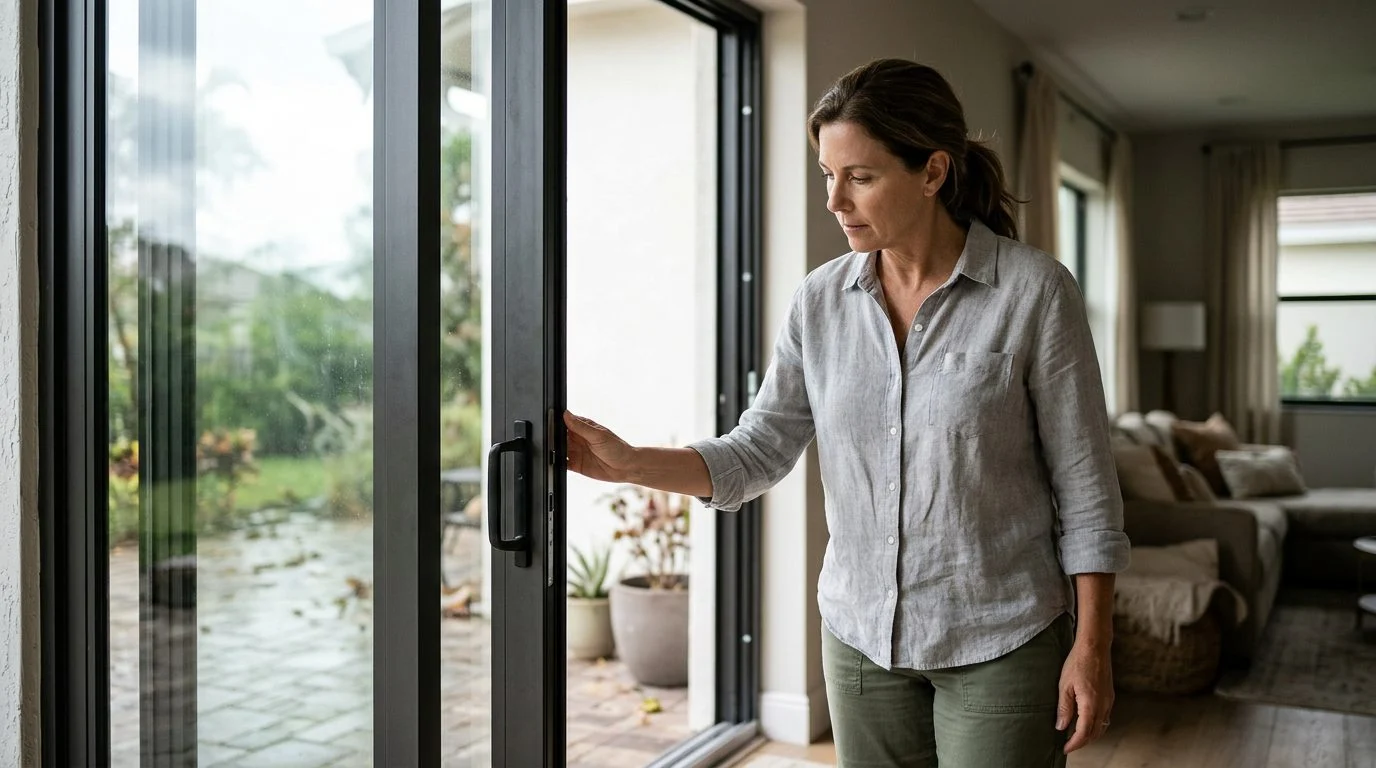
Impact Doors | South Florida
Impact-Rated Sliding Glass Doors Built for South Florida Homes
Compare ratings, frames, and locking systems before you buy. Our free first consultation is confidential and comes with no obligation to continue.
By Jonathan Rodriguez · Published November 5, 2026
Hurricane Proof Sliding Glass Doors: South Florida Guide
When choosing a sliding glass door, start with one tested and listed for impact, then make sure it’s installed to match that listing. Sliding doors are large glass walls, so they need the same care as a window. This guide explains why they fail, how to read an impact rating, and what shapes installation and cost. If you’re researching this for your own home, or for a parent, relative, or tenant, you’re in the right place to start.
If you're weighing this for your own home or a family member's, share your door's size and label details with our team and we'll talk through the options that fit your opening. Talk it through with our team — the first consultation is free, confidential, and carries no obligation.
Why sliding glass doors are a weak point in hurricane winds
Sliding glass doors are weak in hurricane winds because they combine large glass with tracks, rollers, and panels that must stay in place. Any one of those parts can fail, and one failure opens the home to wind and rain.
Glass is the first concern. A flying branch, roof gravel, or a patio chair can break a large pane. Once the glass breaks, wind pushes inside and can damage the room.
Pressure is the second. Wind can push glass inward on one side of the house and pull it outward on the other. That repeated load can crack glass or bow the frame.
The track and rollers are a common failure point. Under strong wind, a panel can jump its rollers or lift out of the track. A door that pops out leaves a large opening in the wall.
An open or broken door also affects the whole house. Wind and rain get in, and the higher pressure inside adds load to walls and the roof. Protecting the opening matters for the whole building.
What ‘impact rated’ means for a sliding glass door
An impact-rated sliding door has been tested as a complete product to resist wind-borne debris and wind pressure.
Impact glass is laminated. Two layers of glass bond to a plastic interlayer, which helps hold the pieces together after a strike. Tempered glass is not the same as a tested impact assembly.
The code names the test methods. The 2026 Florida Building Code supplement says exterior glazed openings in windborne debris regions must be protected. It names the Large Missile Test of ASTM E1996 and ASTM E1886, TAS 201, 202 and 203, or AAMA 506, as applicable. A Florida Building Code supplement states that exterior glazed openings in buildings located in windborne debris regions shall be protected from windborne debris.
Location sets the wind-borne debris region. The Florida Building Code definition covers areas within 1 mile of the coastal mean high water line where ultimate design wind speed, Vult, is 130 mph or greater. It also covers areas where Vult is 140 mph or greater. Whether your home falls inside depends on the facts of its site.
Florida also limits how these products are sold. Statewide approval of products may be achieved by one of the listed methods under Fla. Stat. § 553.842; for local product approval, the methods for showing compliance with the code’s structural windload requirements are in Fla. Stat. § 553.8425. The hurricane and impact marketing ban is in Fla. Stat. § 553.842.
How to check the impact rating on the sliding door you already have
Find the label or approval number on the door, then match it to the product it describes.
Manufacturers usually place labels on the frame, along the glass edge, or near where the panels interlock. Check the fixed panel and the moving panel. Write down any model number, approval number, and rating you can read.
An approval number ties the door to a tested product. Statewide approval can be shown by a certification mark or a listing from an approved certification agency, but that route may be used only for products for which the code designates standardized testing. In Miami-Dade, a Miami-Dade County Notice of Acceptance states that an approved impact-rated product was tested and accepted for Florida Building Code compliance.
A rating covers the full assembly. The glass, frame, track, and anchoring should all match what the approval lists. If a panel or frame was swapped out, the old label may no longer describe the door.
Features that help a sliding door hold up in a storm
Look for laminated glass in both the fixed and moving panels, a reinforced frame, and locking that keeps the panels together.
Laminated glass keeps fragments bonded after impact, so the opening stays covered. A reinforced frame resists the bending that can pull panels apart. Sturdy interlocking panels help keep the moving door tied to the fixed one.
Multi-point locking engages the frame at several places along the edge. A single latch in the middle concentrates the load in one spot. Ask whether the locking system is part of the tested assembly, not an add-on.
Track and roller design matter too. Rollers should hold the panel in the track under load. The track must be anchored so it doesn’t shift. Strong glass paired with a weak track can still fail.
Installation: where storm protection succeeds or fails
A tested door protects you only when it is installed to match its listing.
Sizing and setting come first. The door must be plumb and level, with secure anchoring into the structural framing. Loose anchors let a door shift under wind, even when the glass is rated.
Water is the other risk. Sill, flashing, and sealant details keep rain from driving in during a storm. The 2026 Existing Building code analysis notes a reference to Chapter 14 of the Florida Building Code, Building, and Chapter 7 of the Florida Building Code, Residential. Those references help ensure flashing requirements are met when windows and doors are replaced.
Overhangs matter as well. The 2026 Residential code analysis says doors protected by an overhang now need a Limited Water (LW) rating under AAMA/WDMA/CSA 101/I.S.2/A440. To qualify for the overhang exception, the overhang must extend parallel to each side of the door and perpendicular to it.
Review a repair or replacement as a whole opening, not one part at a time. The frame, sill, anchors, and glass work together.
Not sure what your next step is?
Talk it through with our team — the first consultation is free, confidential, and carries no obligation.
Energy efficiency, cost factors, and what to expect
Cost depends on the door’s size and design, along with the glass, frame, and installation conditions.
Door size and panel count affect price. A wider opening with more panels needs more glass and more track work. Frame material and the glass package also change the total. Access and the condition of the opening can add to the job.
Ask for a written estimate based on your actual opening. Measure the width of each panel and the height. Our team can provide a written estimate for your project.
Permits can apply. Florida Building Code supplement states that replacement windows, doors, or garage doors at an existing one-family home, two-family home, or townhouse may proceed without sealed drawings from a design professional, provided every listed condition is met, including installation according to the manufacturer’s instructions for the applicable wind zone. It must also meet the design pressure requirements of the Florida Building Code, Residential. The replacement must be the same size in the same opening.
Insurance may matter too. The Florida Office of Insurance Regulation describes wind-mitigation inspections and premium savings for qualifying measures. The Florida Department of Financial Services guide describes discounts for qualifying hurricane-resistant construction.

Talk through your sliding glass door with our team
The fastest way to get a useful answer is to know your door’s size, age, and label details.
You may be handling this for a parent, a relative, or a tenant, with a storm on the horizon. Starting with a few facts makes the next conversation easier.
Note the width and height of each panel, the year it was installed if you know it, and any label or approval number. A clear photo of the label helps.
Our first consultation is free, confidential, and carries no obligation to continue.
Is tempered glass the same as impact glass?
No. Tempered glass alone is not a tested impact assembly. Look for a rating that covers the whole door.
Do I need a permit to replace a sliding glass door in Florida?
Not always. Sealed drawings are not required for certain one- and two-family home replacements that meet listed conditions.
Can impact sliding doors lower insurance costs?
They may, if the work qualifies for a wind-mitigation discount. Ask about the inspection and documentation involved.
If you’re weighing this for your own home or a family member’s, share your door’s size and label details with our team and we’ll talk through the options that fit your opening.
What to know before you choose
Rating covers the whole door
Look for an impact rating that applies to the complete door assembly, not just the glass.
Tempered is not the same as impact
Tempered glass alone is not a tested impact assembly. Ask what was tested and how.
Clear documentation
Ask for the product approval and rating details so you can confirm the door matches the listing.
Fit matters as much as the product
A rated door still needs a precise opening, proper anchoring, and sealing to perform as intended.
Key features to compare
Whole-door rating
Confirm the impact rating applies to the full door unit as installed.
Frame and track
A sturdy frame and smooth, well-built track help the door stay aligned over time.
Locking and hardware
Multi-point locking and reinforced hardware add security for the whole opening.
Professional installation
Correct measurements, anchoring, and sealing are essential for the door to perform as rated.


