


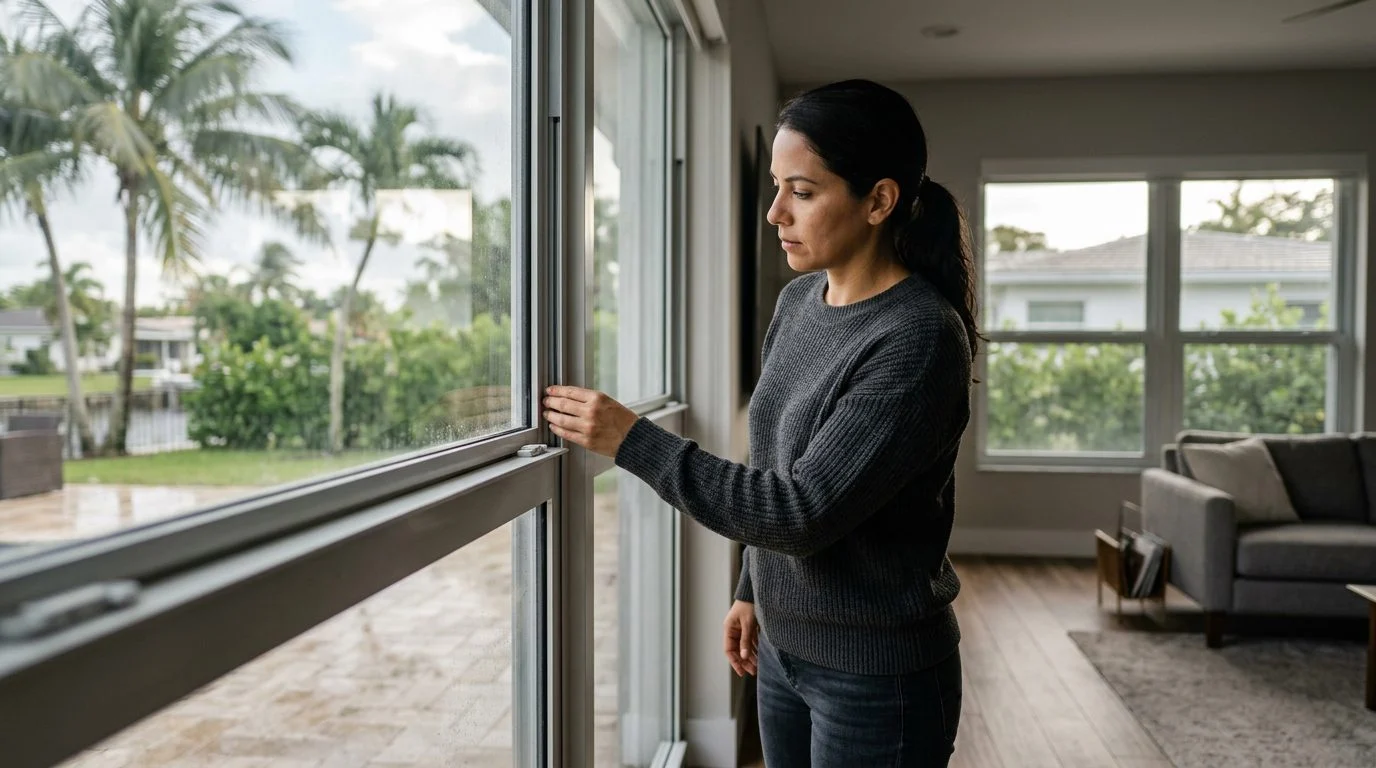
Miami hurricane preparation
Get Your Home Hurricane-Ready Before Storm Season Arrives
A practical pre-season checklist for Miami homeowners covering impact windows, impact doors, roofing, solar, and battery backup.
By Jonathan Rodriguez · Published November 6, 2026
Hurricane windows of Miami only protect a home if they are rated for impact and still in good shape. This five-check list helps you see where a house stands before storm season. Each check is a yes or no question you can answer room by room.
Where You Are Right Now and How to Use This Checklist
If you need to know whether a Miami home’s windows and doors can handle a storm, start here. You may not know the answer yet, and that’s normal.
Maybe you live in another city, and your parents’ house in Kendall has never had a storm check. Maybe you rent out a condo in Fort Lauderdale, and a tenant asked about storm protection. Maybe you inherited a house, and the paperwork is still in a drawer. You didn’t pick this situation, and the season may feel close.
Each check below has one yes or no test, one line of reasoning, and one next step. Write your answers down as you go. Keep the list with any notes from family or tenants. Don’t worry about passing every test. The goal is to find out what needs attention before the season starts.
This checklist covers windows and doors only. For a wider look at product types, read the impact windows guide.
If your checklist turned up gaps in a Miami home you're looking after for someone else, we can talk through the options with you. Talk it through with our team — the first consultation is free, confidential, and carries no obligation.

Does Hurricane Season Really Affect Miami Homes?
Yes. Windows and doors are the openings where storm wind and flying debris can reach the inside of a home.
Miami sits on the coast, where storms bring strong wind and loose objects. A storm doesn’t need to be a direct hit to send debris at glass. One broken window lets wind and rain inside. Once wind gets in, it pushes outward on the walls and roof from the inside, too.
That’s why this checklist focuses on openings. A roof and walls can be sound, yet a single broken window can still let a storm in.
If you’re searching for hurricane windows of Miami, start with what you already have. You can’t judge a product you haven’t identified.
Run these checks before a watch or warning. Once a storm is forecast, there is less time to plan and act. For Miami-specific context, see the Miami impact windows guide.
Check 1: Is Your Window Glass Impact-Rated?
Impact-rated glass is laminated. That means two panes of glass with a plastic layer bonded between them.
Test: Does the glass have two layers with a plastic layer between them? Look at the edge of the pane or any product label on the frame.
Yes. Laminated glass cracks when struck, but the plastic layer helps hold the pieces in place. That helps keep wind and debris out.
No. Standard single-pane glass does not carry the same protection. Note that window for replacement review.
If yes, check the paperwork in Check 5.
Florida law also limits how these products are marketed. Anyone who does so without such approval is subject to the Florida Deceptive and Unfair Trade Practices Act under part II of chapter 501, brought by the enforcing authority as defined in s. 501.203. See Fla. Stat. § 553.842.
Check 2: Are the Frames, Seals, and Anchors Sound?
A window is only as strong as its frame, seals, and anchors. Good glass in a weak frame can fail first.
Test A: Are the frames free of cracks, soft wood, rust, or gaps at the corners? Press gently on the wood or trim. If it feels soft, note it.
Test B: Are the seals and caulking intact, with no gaps where water or air can enter? Look for stains or damp spots near the window after rain.
Test C: Does the window stay firm when you press on the frame? Movement can mean the anchors are loose.
If any answer is no, write down the room and window. Note what you saw, and keep the note with your other results. Check again after the next heavy rain, since water damage often shows up later.
Check 3: Are Your Exterior and Sliding Glass Doors Rated for Impact?
Yes, your entry, patio, and sliding glass doors need the same attention as your windows. Large glass doors face the same debris and pressure.
Test A: Is each exterior door labeled as impact-rated?
Test B: Do sliding doors run on a secure track, and do the locks engage fully when closed?
Test C: Is the door under a roof overhang? The overhang rule changed. The Florida Building Code analysis of changes notes that the exception to water intrusion testing for doors protected by an overhang has been revised, and that such doors are now required to carry a Limited Water (LW) classification under AAMA/WDMA/CSA 101/I.S.2/A440.
If you can’t confirm a rating, record the door and move on to Check 5. For product types, see the impact doors section of the impact windows guide.
Check 4: Do You Have a Plan to Keep Windows Closed During a Storm?
Yes, your plan matters as much as the glass. Keep windows and doors closed during a storm, and decide who checks them before a watch or warning.
Test A: Does every adult in the home know that windows and doors stay closed during a storm?
An open window lets wind inside. Wind inside pushes outward on walls and the roof at the same time, which adds strain.
Test B: Has the household agreed who checks each window and door before a watch or warning?
Test C: Do you have a written list of window and door locations, with notes from Checks 1 to 3?
If you answer no to any test, write a one-page household plan. Keep it with flashlights, water, and other emergency supplies. Tenants need this plan too. Share the list with them so everyone knows their role.
Not sure what your next step is?
Talk it through with our team — the first consultation is free, confidential, and carries no obligation.
Check 5: Can You Find Your Product Certification and Permit Paperwork?
Yes, product labels and permit records show whether a window or door meets Florida’s approval rules. Look for them before you assume protection.
Test A: Can you find the approval or certification label on your windows and doors?
Test B: Do you have permit records for past window or door replacements?
Its Windows, Shutters, Doors and Security Bars page covers those documents.
This applies to an existing one- or two-family dwelling or townhouse. The new unit must match the old size and opening. It must follow the manufacturer’s instructions for the wind zone, meet design pressure requirements, and come with those instructions in the permit application. See the 2024 code supplement.
If you answer no to either test, note the brand and model you can see. Note the year of any past work, too.
What to Do With Your Results and Your Next Step
If most answers are yes, focus on routine care. If several are no, a replacement review is your next step.
Mostly yes means keeping your paperwork together and checking seals after each storm season. Several no answers mean ranking the openings. Start with any window or door that failed Check 1 or Check 2.
If you’re checking this house from another city, managing a rental, or handling a property you inherited, these answers may feel urgent. You don’t need every answer today. Keep a copy of your notes, dated, so you can compare results next year.
Frequently asked questions
Do you open windows in a hurricane?
No. Keep windows and doors closed, because an open window lets wind inside and adds pressure to the walls and roof.
How can I tell if my windows are impact-rated?
Look for an approval label, and check whether the glass is laminated with a plastic layer between two panes.
Is a sealed drawing always required for window replacement?
Whether your project needs engineered documentation depends on its specific details, so our team can review your situation during your free initial consultation, which is confidential and carries no obligation to continue.
Are hurricane windows of Miami the same as any impact window?
Florida law allows hurricane or impact protection claims only for products with the required approval, so look for that approval.
Your first consultation with ASP Superhome is free, confidential, and carries no obligation to continue. Reach out to ASP Superhome and we’ll walk through what your answers mean for the home.
What to look for in your home
Impact-rated openings
Check each window and door for an approval label and confirm the glass is laminated, with a plastic layer between two panes.
Written records
Keep product labels, installation paperwork, and any engineering documents with your home records so they are easy to find.
Roof condition
Look for lifted or cracked tiles, loose metal panels, damaged flashing, and areas where water has already entered.
Solar and battery readiness
Confirm that panel mounts, wiring, and battery backup equipment are secure and working before the season starts.
Keep openings closed during a storm
Do not open windows or doors during a hurricane. An open window lets wind inside and adds pressure to walls and the roof.
Your pre-season checklist
1. Walk the exterior
Clear gutters, remove loose outdoor items, and trim branches that could strike windows, doors, or the roof.
2. Test your openings
Check that every window and door latches, locks, and seals properly, and note any gaps, cracks, or warped frames.
3. Inspect the roof
Look for missing or damaged tiles or panels and worn sealant around vents and penetrations. Repairs are easier before the season begins.
4. Plan power and shelter
Review solar and battery backup equipment, confirm your emergency plan with everyone in the home, and gather essential supplies.


